
How to Prepare for a Career Fair: Resume, Pitch, Follow-Up
How to prepare for a career fair: a printable timeline checklist, a 30-second pitch formula, resume tips, recruiter questions, and a follow-up email template.

Raman M.
Software Engineer & Founder of ResumeFast

On this page
Build a resume that gets interviews
- ATS-optimized templates
- AI-powered writing
- Free to start
No credit card required
Fall recruiting season is here. Your campus career fair is two weeks out, the employer list scrolls forever, and your resume was last updated for a summer job. You don't need to do everything, just three things well.
The three things that matter most at a career fair are a short list of employers you've actually researched, a 30-second pitch that proves one skill with one example, and a follow-up email sent within 24 hours. A one-page resume tailored to those employers supports all three.
These career fair tips are built to be printed. Career centers, feel free to hand them out.
Why You Can't Visit Every Booth
In NACE's 2024-25 Career Services Benchmarks survey of 551 colleges, 93.9% planned in-person career fairs, versus 33.2% virtual. The median in-person fair in 2023-24 drew 109 employers and 700 students.
At 109 employers, you need a plan. Our framework is the A/B/C Booth List: about 5 A-list employers you'd genuinely accept an offer from, 5 B-list employers that fit your field, and 2 or 3 C-list booths you'll use as warm-ups.
The Career Fair Timeline Checklist
| When | Tasks |
|---|---|
| 2 weeks before | Pull the employer list from Handshake or your career center. Build your A/B/C Booth List. Read each A-list employer's open roles and research the company. Make a resume version per tier. Draft your pitch. |
| 2 days before | Print copies. Rehearse your pitch aloud until it fits in 30 seconds. Write two questions per A-list employer on an index card. Check the floor map. |
| The morning of | Reread your A-list notes. Pack resumes, a pen, a notepad and your student ID. Arrive early. Warm up at a C-list booth. |
| At the booth | Introduce yourself, deliver your pitch, ask one question, offer your resume, and ask how to follow up. Step away and note one specific detail. |
| Within 24 hours | Send a personalized follow-up email. Apply online if asked. Connect on LinkedIn with a one-line note. Log every contact. |
If talking to strangers drains you, see our guide to networking for introverts.
The Present-Proof-Point Pitch
"Tell me about yourself" at a booth is a 30-second test. Our Present-Proof-Point pitch has three beats:
- Present: who you are now (name, year, major, focus).
- Proof: one specific thing you did, ideally with a number.
- Point: why you're at this booth, ending with a question.
Proof is the beat students skip and employers want. In NACE's Job Outlook 2026 Spring Update, teamwork, problem-solving and communication led the skills employers look for on resumes, with 85% of employers looking for teamwork. NACE's point: listing a skill isn't enough, employers want examples.
Computer science student:
"Hi, I'm Priya, a senior in computer science focused on backend systems. Last summer I interned at a logistics startup, where I rewrote a slow reporting API and cut its response time from about four seconds to under one. I saw you're hiring new-grad engineers for the payments platform. What do the first six months look like on that team?"
Marketing student:
"Hi, I'm Marcus, a junior in marketing. I run social media for our campus food bank, and switching to short volunteer stories took us from about 400 to 2,100 followers in one semester. I'm looking for a summer marketing internship, and your brand team posts a lot of creator content. How are interns involved in that?"
What not to say:
"Hi, I'm Marcus. So, um, what does your company do? I'm open to anything, really. Are you hiring?"
No proof, no point, and a question their homepage answers.
Career Fair Resume: What Changes
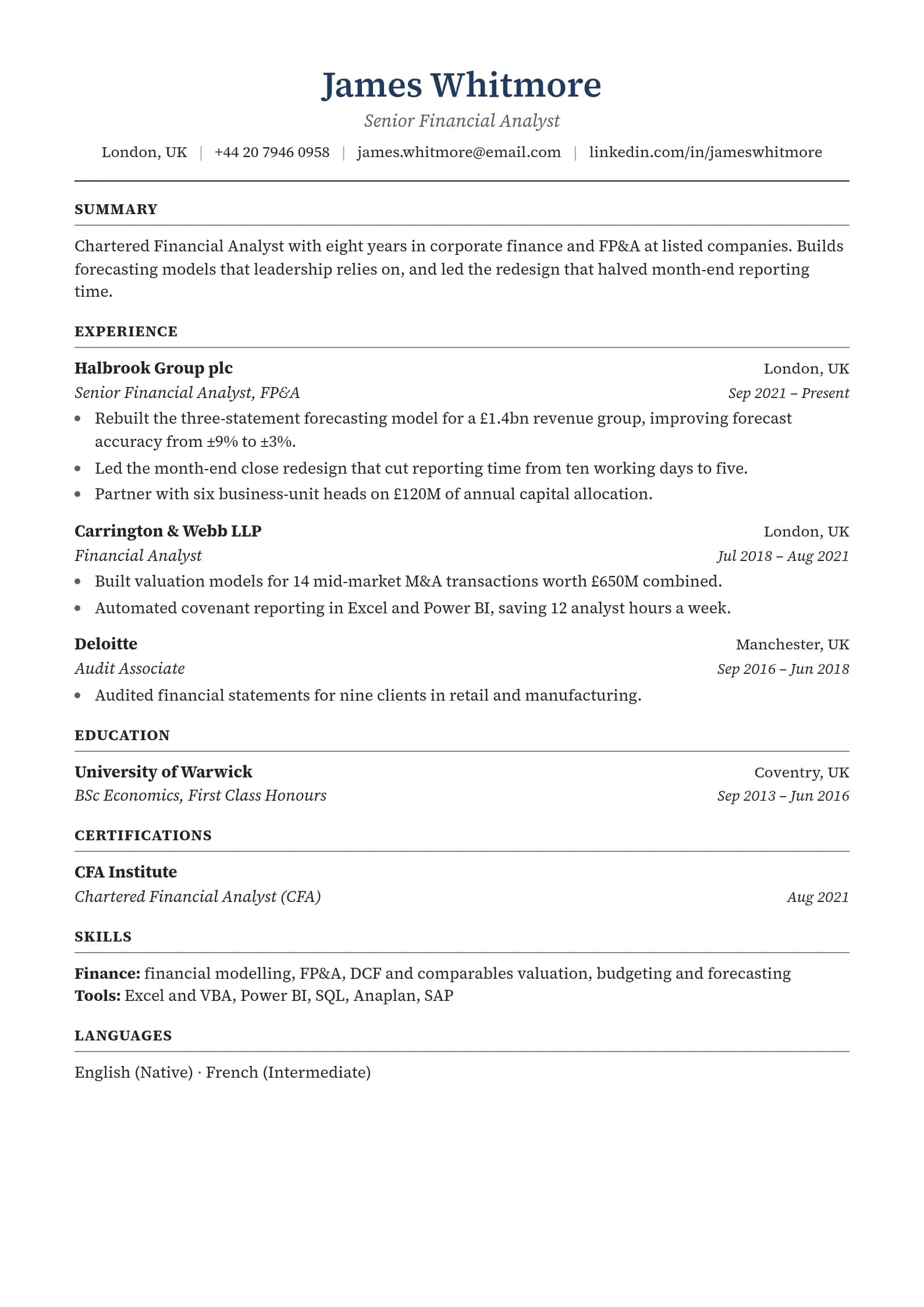
Your career fair resume is the one you'd send online, with a few fair-specific choices. Our new grad resume guide covers the full structure.
- One page. The recruiter reads it standing up.
- A version per tier. Tailor one to each A-list role family and keep a general version for the B-list. The free keyword matcher compares your resume to a job posting with no sign-up.
- Lead with internships, then projects. In NACE's Job Outlook 2026, an internship with the employer and an internship in its industry were the only attributes rated as having "very much influence" between equal candidates. No internship yet? A strong projects section supplies the proof.
- GPA matters less than it did. NACE reports that 42% of employers screen by GPA, down from 73% in 2019. Include yours if it's 3.0 or higher or the posting asks.
- Copies: our rule is two per target employer plus five spares, so ten targets means 25 copies, carried flat in a folder.
- A QR code, done carefully. Use a static code that encodes your LinkedIn URL directly, test it on two phones, and print the URL as text too, because ATS software can't read an image. Then align your LinkedIn with your resume.
ATS still matters. Many recruiters will still ask you to apply online, so the same resume lands in an applicant tracking system. Use standard headings, one column and real text.
To keep an A-list and a B-list version side by side, ResumeFast is free to build and holds as many resume versions as you need. PDF and Word downloads are part of Pro at $6.95 a month.
Questions to Ask Recruiters
- "What does a strong first year look like for new hires on this team?"
- "What separates the interns who get return offers from the ones who don't?"
- "What happens after today: an online application, a screening call, an assessment?"
- "Which teams are hiring the most entry-level people this year?"
- "What would you like to see on my resume that isn't there now?"
- "What's the best way to follow up with you?"
Question 2 pays off. NACE's 2026 Internship & Co-op Survey found that 63.1% of 2024-25 interns converted to full-time hires on average, the highest rate in five years. Our guide to turning an internship into a full-time offer covers the next step.
Questions to avoid: "What does your company do?", "Are you hiring?", and opening with salary or vacation days. Save pay for the screening call or the offer.
Virtual Career Fairs: What Changes
Virtual fairs are shrinking: in NACE's 2025 Internship & Co-op Survey, employer participation fell from 94.2% in 2021 to 58.8% in 2024. But if an employer you want is only there, the booth becomes a scheduled video session:
- Sign up early. At UC Santa Barbara's Handshake fairs, for example, 1:1 sessions run 10 minutes and group sessions run 30 minutes with up to 50 students.
- Your profile is your first impression. Upload a PDF resume and make your profile visible to employers.
- Write a chat version of your pitch. At UCSB, group sessions with more than 15 participants switch off student audio and video, so the chat box may be your only voice.
- Test your camera and mic the day before.
The Follow-Up Email Template
Send it within 24 hours. For variations, see our follow-up email guide and, once interviews start, our thank-you email guide.
Subject: Great meeting you at the [University] Career Fair
Hi [Name],
Thank you for talking with me at the [University] Career Fair yesterday. I enjoyed hearing about [specific detail they mentioned], and it made me even more interested in the [role title] position.
As I mentioned, [your Proof beat in one sentence]. I've applied online as you suggested and attached my resume here for convenience.
I'd welcome the chance to talk further. Thank you again for your time.
Best, [Your name] [LinkedIn URL] | [Phone]
The specific detail is the whole email. It proves you listened.
A career fair is one channel, not the whole plan: our job search strategy guide shows how it fits with referrals and applications. When you're ready, build and tailor your resume in ResumeFast for free.
Frequently Asked Questions
What should I bring to a career fair?
Bring printed copies of your tailored resume in a folder, a pen, a small notepad, your student ID, and a list of target employers with two questions for each.
How many resumes should I bring to a career fair?
A practical rule is two copies per target employer plus five spares. For ten employers, bring about 25 copies, with each tailored version labeled in your folder.
What do I say when I walk up to a recruiter at a career fair?
Give a 30-second pitch in three parts: who you are now, one specific thing you did that proves a relevant skill, and why you came to their booth, ending with a question.
Are virtual career fairs worth attending?
Yes, if an employer you want is recruiting there. Book sessions early, upload a PDF resume to your profile, and prepare a two-sentence written pitch, because in large group sessions the chat may be your only way to speak.
Your resume is your first impression. Make it count.
Build an ATS-optimized resume that gets read, with AI help on every section.
No credit card required. PDF and Word downloads are $6.95 a month with Pro.
Continue Reading
View all articles
How to Cold-Message Recruiters on LinkedIn (Templates That Get Replies)

Your LinkedIn and Resume Tell Different Stories (How to Fix That Before Graduation)

New Grad Resume Guide: How to Get Hired in 2026 Without Experience

AI Killed Entry-Level Jobs: What to Do Now

Why Your College Degree Isn't Working in 2026

High School Grads Are Getting Hired Faster. Why?
Build a resume that gets interviews
Ready to build your resume?