
How to List Certifications on a Resume (25+ Examples)
How to list certifications on a resume: where to put them, the exact format, in-progress certifications and licenses, plus 25+ examples by field.

Raman M.
Software Engineer & Founder of ResumeFast

On this page
Build a resume that gets interviews
- ATS-optimized templates
- AI-powered writing
- Free to start
No credit card required
List certifications in their own section, one per line: the certification name, the issuing organization, and the year you earned it, plus the expiry date if it has one. Put the section below your experience, or right under your summary when the job requires the credential. Add an in-progress certification with "Expected" and a month.
That is the whole rule. The rest of this guide covers the cases where it bends: required licenses, certifications you're still studying for, expired credentials, online course certificates, and what the section looks like in 12 different fields.
The Certification Format to Copy
Every certification line answers three questions for the reader: what is it, who says you have it, and is it current? Use this order:
Certification Name (Acronym), Issuing Organization, Year Earned
Add the extras only when they help:
Project Management Professional (PMP), Project Management Institute, 2023 AWS Certified Solutions Architect, Associate, Amazon Web Services, 2025 (valid through 2028) Registered Nurse (RN), Texas Board of Nursing, License #123456, Active Certified Information Systems Security Professional (CISSP), ISC2, Expected March 2027
Four formatting rules keep the section clean:
- Write the full name and the acronym once. "Project Management Professional (PMP)" matches a recruiter who searches either form, and a person who doesn't know the acronym still understands it.
- Use the official name. "AWS Solutions Architect cert" looks careless next to "AWS Certified Solutions Architect, Associate".
- Pick one date style and keep it. "2025" or "Mar 2025", the same way on every line and in your work experience section.
- Add a credential ID or license number only where employers verify it. Nursing, accounting, trades and cloud certifications are commonly checked; a marketing course certificate is not.
Where to Put Certifications on a Resume
Placement tells the reader how much the credential matters. Use the job posting to decide.
| Your situation | Where certifications go | Example |
|---|---|---|
| The job requires a license or certification (nursing, CPA, electrician, CDL) | Directly under your summary, headed "Licenses & Certifications" | Licensed RN applying to a hospital |
| The credential is your strongest qualification for a role you haven't done yet | Above experience, under the summary | Career changer with a new Google Data Analytics certificate |
| The certification supports experience you already have | Its own section below experience, before or after education | Cloud engineer with AWS and Azure certifications |
| You only have one or two minor certificates | Combined "Education & Certifications" or "Skills & Certifications" section | Graduate with a HubSpot certificate |
You can also put a top credential after your name: Maria Lopez, RN or David Kim, CPA, PMP. Do this only for credentials your field treats as part of your title (RN, CPA, PE, PMP, CFA). "Jane Smith, Google Analytics Certified" reads as padding.
If the job posting names a certification as required, the reader should find it in the first third of the page. A recruiter scanning for "PMP" or "RN license" should never have to reach the bottom of page two.
How to List Certifications in Progress
You can list a certification you're actively working toward. Mark it so nobody mistakes it for one you hold:
Certified Public Accountant (CPA), passed AUD and FAR, BEC scheduled, Expected December 2026 AWS Certified Solutions Architect, Associate, Amazon Web Services, In progress, exam booked for January 2027 Google Data Analytics Professional Certificate, Google via Coursera, 6 of 8 courses complete, Expected November 2026
Three rules:
- Use "Expected", "In progress" or "Candidate", never just a date. A bare "2027" reads as earned.
- Only list what you've started. A study plan you haven't begun doesn't belong on a resume. A booked exam, enrolled course or passed section does.
- Update it the day you pass. An "Expected June 2026" line in October 2026 makes the reader wonder what happened.
For credentials with levels, name the level you've reached: "CFA Level II Candidate, CFA Institute" is clear and accurate.
How to List Licenses on a Resume
A license and a certification are not the same thing. The U.S. Bureau of Labor Statistics defines a certification as a credential "issued by a non-governmental body" and a license as one "awarded by a government agency" that conveys "a legal authority to work in an occupation". Nurses, teachers, electricians, accountants, real estate agents and commercial drivers need a license to do the job. Credentials are common: in 2025, 24.0% of employed people in the US held an active certification or license, according to the same BLS survey.
Licenses need three details certifications often don't:
- The issuing state or agency, because licenses are state-specific: "Texas Board of Nursing", "State of Ohio".
- The status: "Active", "Current" or the expiry date. Many employers verify this before an offer. Nurses, for example, can be looked up on Nursys, the license database run by the National Council of State Boards of Nursing.
- The license number, if your field expects it. Healthcare and the trades usually do. Leave it off for a general office application.
Licenses & Certifications Registered Nurse, Texas Board of Nursing, Compact (multistate) License #123456, Active Basic Life Support (BLS) Provider, American Heart Association, expires 04/2027 Advanced Cardiovascular Life Support (ACLS) Provider, American Heart Association, expires 04/2027
Use the heading "Licenses & Certifications" when you have both. One combined section is easier to scan than two short ones.
Certifications on Resume Examples by Field
These are ready-to-copy lines. Swap in your own dates, states and numbers. If you're not sure a credential is recognized in your field, the U.S. Department of Labor's CareerOneStop Certification Finder lists certifications by occupation.
Healthcare
Registered Nurse (RN), California Board of Registered Nursing, License #123456, Active Basic Life Support (BLS) Provider, American Heart Association, expires 08/2027 Pediatric Advanced Life Support (PALS) Provider, American Heart Association, expires 08/2027 Certified Nursing Assistant (CNA), Texas Nurse Aide Registry, Active Certified Pharmacy Technician (CPhT), Pharmacy Technician Certification Board, 2024 Certified Professional Coder (CPC), AAPC, 2023
For a full healthcare resume with this section in place, see the registered nurse resume example.
IT and cloud
AWS Certified Solutions Architect, Associate, Amazon Web Services, 2025 (valid through 2028) Microsoft Certified: Azure Administrator Associate (AZ-104), Microsoft, 2025 CompTIA Security+, CompTIA, 2024 Cisco Certified Network Associate (CCNA), Cisco, 2023 Certified Kubernetes Administrator (CKA), The Linux Foundation, 2024
Cloud certifications expire, so the date matters. AWS certifications stay valid for three years after you pass, while Microsoft's associate and expert certifications must be renewed every year through a free online assessment. A "valid through" date answers the question before the recruiter asks it.
Cybersecurity
Certified Information Systems Security Professional (CISSP), ISC2, 2022 Certified Ethical Hacker (CEH), EC-Council, 2023 CompTIA CySA+, CompTIA, 2024
Project management
Project Management Professional (PMP), Project Management Institute, 2023 Certified ScrumMaster (CSM), Scrum Alliance, 2024 PRINCE2 Practitioner, PeopleCert, 2022 Certified Associate in Project Management (CAPM), Project Management Institute, 2025
PMP on a resume: put "PMP" after your name and list the full line in your certifications section. Project manager job postings often name the PMP, so it should be visible in the top third of the page. See it in context on the project manager resume example.
Data and analytics
Google Data Analytics Professional Certificate, Google via Coursera, 2025 Microsoft Certified: Power BI Data Analyst Associate (PL-300), Microsoft, 2025 Tableau Certified Data Analyst, Tableau, 2024
The data analyst resume guide covers how to pair these with a projects section.
Finance and accounting
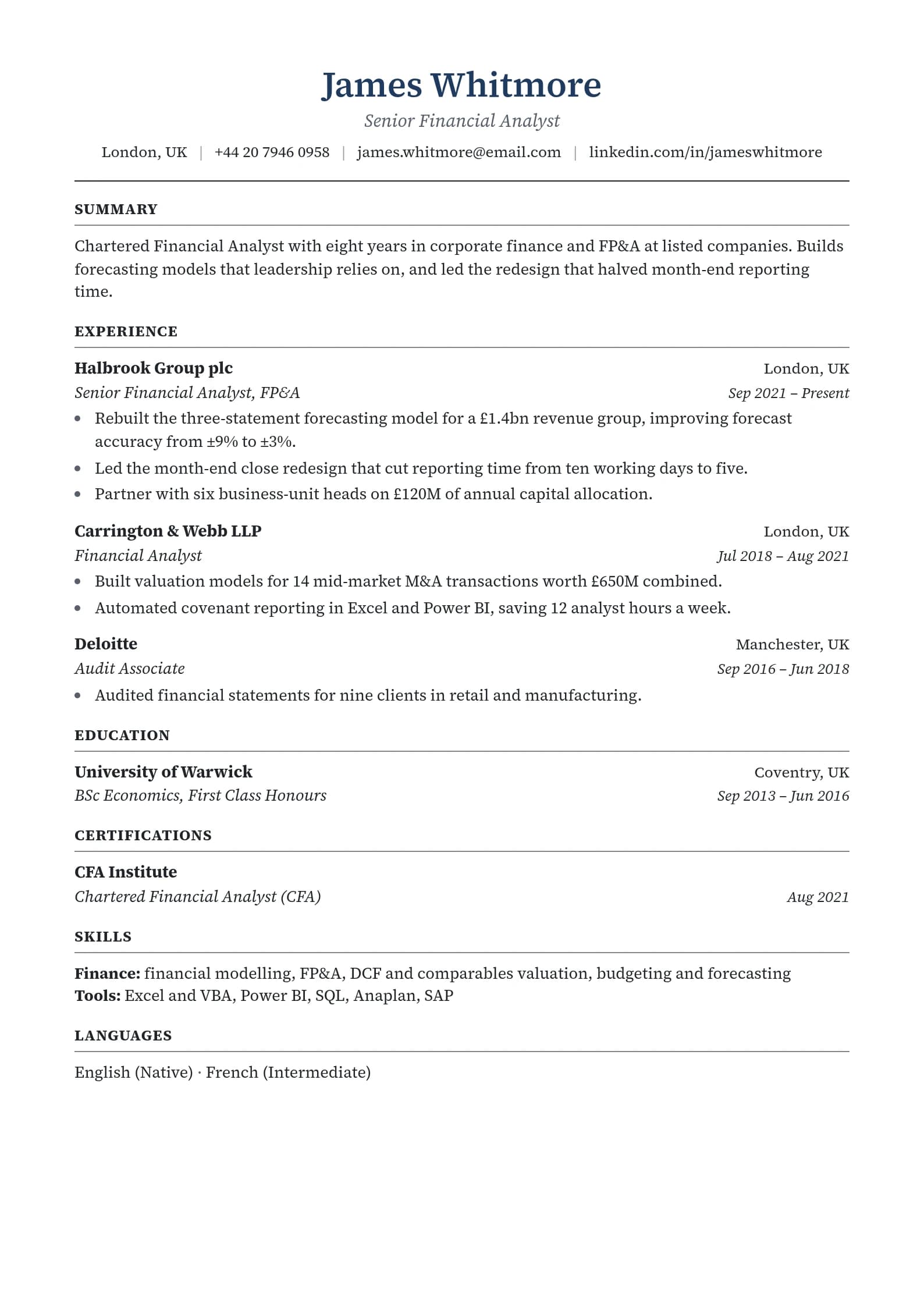
Certified Public Accountant (CPA), State of Ohio, License #12345, Active Chartered Financial Analyst (CFA) Charterholder, CFA Institute, 2021 FINRA Series 7 and Series 66, registered 2022 Certified Management Accountant (CMA), Institute of Management Accountants, 2024
Human resources
SHRM Certified Professional (SHRM-CP), Society for Human Resource Management, 2024 Professional in Human Resources (PHR), HR Certification Institute, 2023
Marketing
Google Ads Search Certification, Google Skillshop, 2025 HubSpot Content Marketing Certification, HubSpot Academy, 2025 Google Analytics Certification, Google Skillshop, 2025
Skilled trades
In the trades, the license is often the first thing a foreman or owner checks, so it goes at the top of the page.
Journeyman Electrician License, Texas Department of Licensing and Regulation, #123456, Active EPA Section 608 Universal Technician Certification, 2022 OSHA 30-Hour Construction Outreach Training (DOL card), 2024 American Welding Society (AWS) Certified Welder, structural plate, 2023 Commercial Driver's License (CDL), Class A, Hazmat endorsement, State of Ohio
Two details trip people up. HVAC employers screen for EPA Section 608 technician certification, the federal credential for working with refrigerants, so name the type (Type I, II, III or Universal). And OSHA's 10-hour and 30-hour courses give you a completion card, not a certification: OSHA states that "none of the courses within the Outreach Training Program is considered a certification". Write "OSHA 30-Hour Construction (DOL card)" rather than "OSHA certified".
For a trades resume, list tools and equipment as your skills (conduit benders, megohmmeters, recovery machines), describe jobs by type and scale ("residential new construction, service upgrades to 200A"), and include your apprenticeship under training.
Education
Professional Educator License, Illinois State Board of Education, Elementary Education (Grades 1-6), valid through 2029 TEFL Certificate (120 hours), International TEFL Academy, 2022
Food service, real estate and other licensed jobs
ServSafe Food Protection Manager Certification, National Restaurant Association, 2025 Real Estate Salesperson License, New York Department of State, Active Certified Fitness Trainer, National Academy of Sports Medicine (NASM-CPT), 2024
Certification vs. Certificate: What Counts on a Resume
A certification is a credential you earn by passing an assessment set by an independent body, and usually renew. PMP, CPA, CompTIA Security+ and AWS certifications are certifications. A certificate shows you completed a course or program. Coursera, LinkedIn Learning, Udemy and bootcamp certificates are certificates.
Both can go on a resume. They just carry different weight, so treat them differently:
| Certification | Certificate | |
|---|---|---|
| Earned by | Passing a proctored exam, often plus experience | Finishing a course |
| Expires | Often, renewed with continuing education | Rarely |
| Verified by employers | Commonly, through the issuer's lookup | Rarely |
| Where it goes | "Certifications" or "Licenses & Certifications" | "Professional Development", "Training" or with education |
How to add a Coursera, Google or LinkedIn Learning certificate
Name the program, then the provider and the platform:
Google Project Management Professional Certificate, Google via Coursera, 2025 Machine Learning Specialization, Stanford University and DeepLearning.AI via Coursera, 2024
Include them when they fill a real gap: a career changer showing new skills, a graduate without work experience in the field, or a specific tool the posting asks for. Skip them when your experience already proves the skill. A Coursera certificate in Excel adds nothing to the resume of someone who has built financial models for five years.
If a certificate came with a capstone project, the project is often worth more than the certificate line. Describe it in a projects section with what you built and what it showed.
Certifications on a Resume for Freshers
If you're a fresher or recent graduate with little work experience, certifications can carry more of the page. Put them right after education, or above it if they're more relevant to the job than your degree:
Education B.Com, University of Mumbai, 2025
Certifications Google Data Analytics Professional Certificate, Google via Coursera, 2025 Microsoft Excel Expert (MO-211), Microsoft, 2025 NISM Series V-A: Mutual Fund Distributors Certification, NISM, 2024
Choose two to five that match the job. Ten certificates from unrelated short courses make it harder to see the two that matter. Our guide to listing education on a resume shows how to order the two sections.
Skills and Certifications: One Section or Two?
When you have only one or two credentials, a combined "Skills & Certifications" section saves space:
Skills & Certifications Tools: Salesforce, HubSpot, Excel (pivot tables, XLOOKUP), Tableau Certifications: Salesforce Certified Administrator (2024), HubSpot Inbound Marketing (2025)
Once you have three or more, or any required license, give certifications their own section so they don't get lost in a list of tools.
Expired Certifications
Leave off a certification that has expired, unless you're renewing it. If you are, say so:
AWS Certified Solutions Architect, Associate, Amazon Web Services, 2021-2024 (renewal exam scheduled February 2027)
Never list an expired license as current. Employers verify licenses, and a mismatch between your resume and the issuer's records can end an application or lose you an offer.
Before and After: A Certifications Section Rewrite
Before: one long line, no order, no dates.
Certifications: AWS Cloud Practitioner, Udemy Python Bootcamp, Coursera Machine Learning, CompTIA A+, LinkedIn Learning Docker Essentials, AWS Solutions Architect Associate, Google IT Support Certificate
After: certifications first, course certificates separated, newest first.
Certifications AWS Certified Solutions Architect, Associate, Amazon Web Services, 2025 AWS Certified Cloud Practitioner, Amazon Web Services, 2024 CompTIA A+, CompTIA, 2023
Professional Development Google IT Support Professional Certificate, Google via Coursera, 2023
The Udemy and LinkedIn Learning entries are gone: next to two AWS certifications, they don't add anything the reader will use.
Common Mistakes
- Listing the same certification twice, once in skills and once in certifications.
- Abbreviations only. "CSM, PSM, SAFe" means little to a recruiter outside agile teams.
- Burying a required license at the bottom of page two.
- Every certificate you've ever earned. Keep what's relevant to this job; your LinkedIn profile can hold the rest.
- Wrong status. "Active" on a lapsed license is the fastest way to lose an offer.
Build the Section in Minutes
In ResumeFast's resume builder, the certifications section has fields for the name, issuing organization, issue date, expiry date and credential ID, so every line comes out in the same format. You can rename it to "Licenses & Certifications" and drag it above your experience. The Healthcare and Skilled trades starting points put it at the top for you. Building is free, and your first PDF or Word download is free.
For the rest of the page, the resume writing guide walks through every section in order, and the ATS checker shows whether your certifications are read correctly by applicant tracking systems.
Frequently Asked Questions
Where do certifications go on a resume?
In their own section, usually below work experience. Move the section directly under your summary when the job requires the credential (nursing, accounting, trades, CDL) or when it is your strongest qualification for a new field.
How do you list a certification in progress on a resume?
Write the certification name, the issuer and 'Expected' with a month, for example: Certified Information Systems Security Professional (CISSP), ISC2, Expected March 2027. Only list certifications you have actually started, such as a booked exam or an enrolled course.
How do I list licenses and certifications on a resume?
Use one section headed 'Licenses & Certifications'. For a license include the issuing state or agency, the status or expiry date, and the license number if your field expects it. For a certification include the name, issuer and year.
Should I include expired certifications on my resume?
Generally no. Include an expired certification only if you are renewing it, and show the dates and the renewal plan. Never list an expired license as active.
Should I put Coursera or LinkedIn Learning certificates on my resume?
Yes, when they fill a gap the job cares about, such as a career change or a tool the posting names. Put them under 'Professional Development' or 'Training' rather than mixing them with proctored certifications.
How many certifications should I list on a resume?
List the ones relevant to the job you are applying for. For most people that is two to six. A long list of unrelated course certificates makes the important ones harder to find.
Can I put certifications next to my name?
Yes, for credentials your field treats as part of your professional title, such as RN, CPA, PE, PMP or CFA. List the full certification in your certifications section as well.
Your resume is your first impression. Make it count.
Build an ATS-optimized resume that gets read, with AI help on every section.
No credit card required. Your first PDF or Word download is free; after that, Pro is $6.95 a month.
Continue Reading
View all articles
Resume Experience Section: How to Write It (Examples)

How to List Contract Work on a Resume (With Examples)

Declaration in Resume: 8 Samples to Copy (and When to Skip)

Career Objective for Freshers: 60+ Examples to Copy (2026)

Resume for Freshers: Format, Skills and Examples (2026)

Hobbies and Interests on a Resume: When and How (Examples)
Build a resume that gets interviews
Ready to build your resume?