
Career Change Resume: Format, Examples and Templates
Write a career change resume that gets read: summary formulas, transferable skills, before/after bullets, format advice and links to guides for specific jobs.

Raman M.
Software Engineer & Founder of ResumeFast

On this page
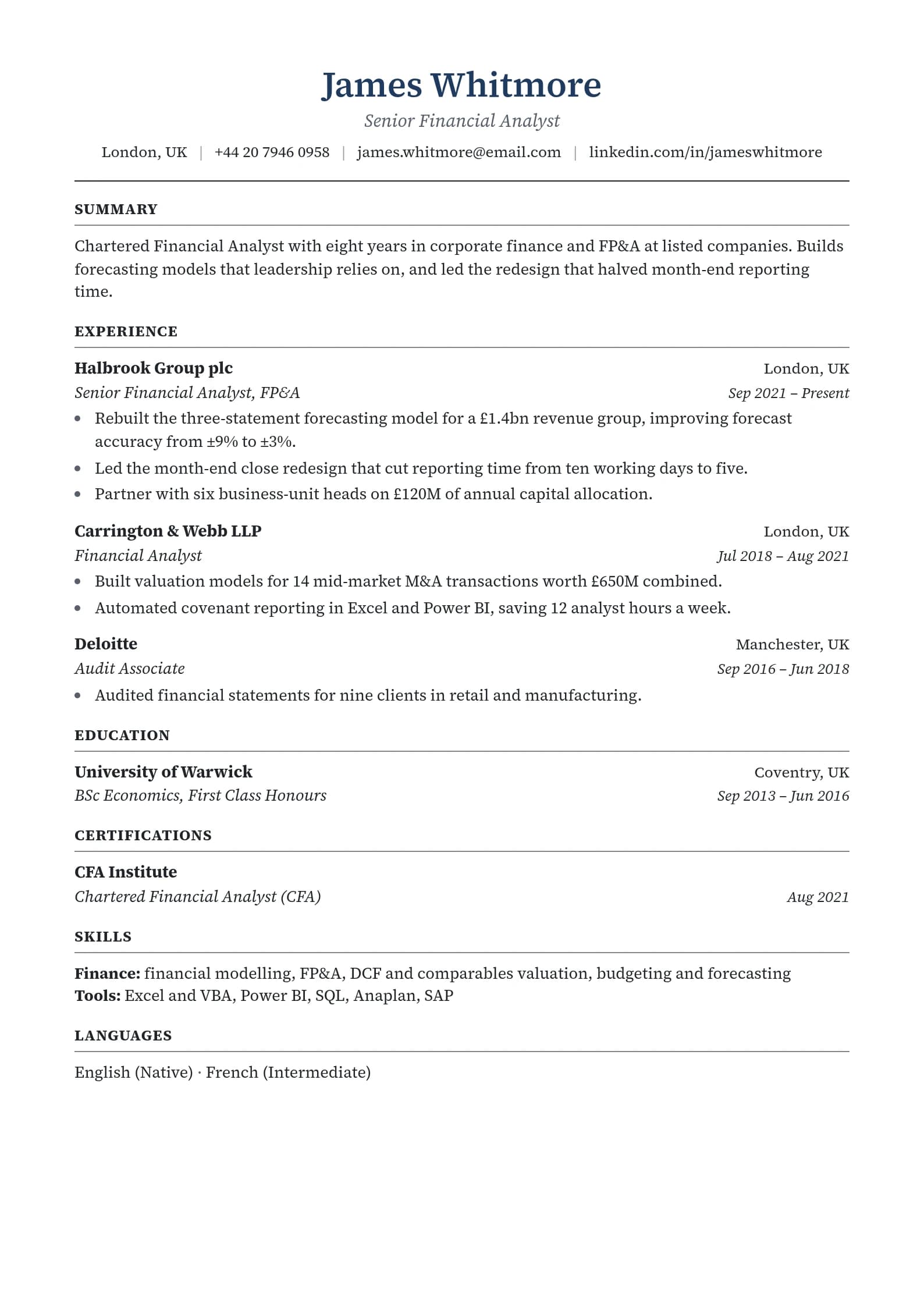
Build a resume that gets interviews
- ATS-optimized templates
- AI-powered writing
- Free to start
No credit card required
A career change resume leads with a summary that names your target role and your most relevant proof, then shows transferable skills and results that match the new job's language. Use a combination format (summary, skills, then reverse-chronological experience), keep your real job titles, and rewrite each bullet around what the new employer needs.
You've built real expertise in one field and want out. Maybe teaching drained you, nursing burned you out, or a corporate path lost its meaning. The problem is that your resume says "wrong industry" before anyone reads a bullet. Every posting asks for years of experience you don't have on paper.
You are not starting from zero. You are translating. This guide gives you the method, then points you to step-by-step guides for specific moves.
Pick Your Path: Guides for Specific Career Changes
Start here if your situation matches one of these. Each guide has before/after bullets, a translation dictionary and interview answers for that move.
| Your move | Read this |
|---|---|
| Nurse leaving the bedside | Nurse career change resume |
| Clinician moving into technology | Healthcare to tech resume |
| Leaving healthcare entirely | Medical to non-medical resume |
| Retail or customer service to an office job | Retail to office resume |
| Teacher to corporate or tech | Teacher career change resume |
| Military to civilian | Military to civilian resume |
| Federal worker to private sector | Federal to private sector resume |
| Gig work to a full-time job | Gig economy to full-time resume |
| Career break or layoff in the way | Returning to work after a career break, Resume after being laid off or fired |
How a Career Change Resume Differs
A traditional resume proves you have done this job before. A career change resume proves you can do this job now.
| Traditional resume | Career change resume |
|---|---|
| Leads with titles and tenure | Leads with a target-role summary and skills |
| Uses industry jargon | Uses the target field's words |
| Chronology is the story | Relevance is the story |
| Responsibilities | Results that match the new role |
Why Career Change Applications Stall
Sending the same resume everywhere
Your current resume is written for your current field. Rewrite the summary, skills and bullets for each target role. The job description analyzer shows which terms a posting emphasizes.
Leading with a title that says "wrong fit"
A summary that opens with the target role and your most relevant proof lets a reader decide before they hit the old title.
Hiding transferable skills inside industry language
"Administered medications" does not tell a software team anything. "Followed strict procedures for accuracy under time pressure" does.
Apologizing for the change
"Seeking to break into" and "although I have no experience in" frame you as a risk. Describe what you bring.
Find Your Transferable Skills (a 30-Minute Exercise)
Transferable skills are abilities that work across jobs and industries: communication, leadership, analysis, organization, negotiation, teaching, technical fluency.
- List 10 to 15 accomplishments from any job, including ones that feel irrelevant: a process you fixed, a person you trained, a project you finished, a problem you solved.
- Name the skill behind each. "Trained a new hire who became a top performer" is coaching and onboarding. "Rebuilt the weekly schedule" is planning and resource allocation.
- Look for patterns. Skills that appear three or more times are your strongest.
- Match them to the posting. Circle the skills the job description repeats, then use that wording where it is true.
Group what you find into categories a reader recognizes:
| Category | Examples |
|---|---|
| Communication | Presenting, writing, persuading, training |
| Leadership | Supervising, mentoring, decision-making |
| Analysis | Data interpretation, research, troubleshooting |
| Organization | Project management, prioritization, process improvement |
| Technology | Software proficiency, data management |
How common moves translate
| From | Skill you have | How to say it |
|---|---|---|
| Teaching | Classroom management | Managing a group of 30 stakeholders with different needs |
| Teaching | Curriculum design | Program and content development |
| Healthcare | Patient education | Training and consultative communication |
| Healthcare | Documentation | Compliance and reporting |
| Retail | Cash handling | Financial accuracy |
| Military | Mission planning | Operations and project planning |
The Career Change Resume Structure
1. A summary that names the target role
This is the most important section. Use this formula:
[Target role or goal] + [your real background] + [one relevant proof] + [the value you bring]
Be honest about your background. Say what you did, not a title you never held.
Teacher to corporate trainer:
Teacher with 8 years designing and delivering lessons to groups of 30 and tracking progress with assessment data. Built and ran a peer-training program for new staff. Looking to bring instructional design skills to a corporate learning and development role.
Nurse to case management:
Registered Nurse with 10 years in cardiac and medical-surgical care, with discharge planning and care coordination experience. Strong at patient education and documentation. Looking to move into hospital case management.
Accountant to data analyst:
Senior accountant with 7 years in financial reporting, advanced Excel and SQL, and a recent Google Data Analytics certificate. Built automated month-end reports. Looking to apply analytical rigor and finance knowledge to a data analyst role.
The same formula works as an objective. Career changers are one of the few groups for whom a short objective-style opening makes sense, because it explains the transition before a recruiter assumes anything. Keep it to two to four sentences and focus on what you will do, not what you want. The summary vs objective guide covers the choice in more depth.
Weak: "Seeking a corporate training position where I can use my teaching background." Better: "Teacher with 8 years of curriculum design and adult mentoring, applying instructional design skills to corporate learning programs."
2. A skills section that mirrors the posting
List 8 to 15 skills, grouped. Mix hard skills for the new field (including ones you recently learned), transferable skills and tools. Only list what you can talk about in an interview.
SKILLS
User research: Interviews, usability testing, surveys
Design tools: Figma (portfolio projects), wireframing
Data: Excel, basic SQL, A/B test analysis
Collaboration: Stakeholder communication, presentations
3. Experience, reframed
Keep your real titles and dates. Employers verify them. Reframe the bullets below the title. The numbers in this guide are placeholders: replace them with figures you can support, or describe scope (how many people, how often).
Before (teacher applying for corporate training):
High School English Teacher | Lincoln High School | 2018-2025
- Taught 9th grade English to classes of 30 students
- Created lesson plans following state curriculum standards
- Graded papers and maintained gradebook
After:
High School English Teacher | Lincoln High School | 2018-2025
- Designed and delivered learning programs for 150 learners a year, adapting content for different skill levels
- Wrote curriculum aligned to measurable objectives and used pre- and post-assessments to check results
- Tracked progress with data and set up targeted support for learners who fell behind
Before (store manager applying for project management):
Store Manager | Retail Co. | 2017-2025
- Managed store operations
- Supervised team of 45 employees
- Handled customer complaints
After:
Store Manager | Retail Co. | 2017-2025
- Managed a store P&L and labor budget and made weekly staffing and inventory decisions
- Led 45 employees through hiring, training, scheduling and reviews
- Planned and delivered a store remodel and two system rollouts, coordinating vendors and staff
Grade your rewritten bullets with the bullet point grader. The bullet point formula explains the structure.
4. Relevant projects, volunteering or freelance
Anything that shows you can do the new work belongs near the top, even if unpaid.
PROJECTS
Mobile app redesign | Personal project | 2025
- Interviewed 8 users to find pain points in a booking flow
- Built wireframes and a clickable prototype in Figma
- Tested the prototype with 5 people and revised the checkout step
5. Education and credentials
Recent certificates and coursework prove commitment: Google career certificates, HubSpot, cloud provider certifications, state licenses. Place them where a reader sees them, and see certifications on a resume for formatting. Older degrees can appear without dates.
Which Resume Format Should You Use?
Use a combination format: summary and skills first, reverse-chronological experience below. Purely functional resumes hide dates and jobs, which many recruiters distrust and many applicant tracking systems read poorly. See how ATS systems work and the best resume format for ATS. Keep it to one page for under 10 years of experience and two for more; the length calculator helps.
Address the Gap Directly
In the cover letter
Name the change in the first paragraph:
My background is in nursing, not sales, and I think that is a strength. I spent ten years on the other side of the conversation with clinicians, so I know the objections and how decisions get made.
The cover letter builder can structure the letter for you.
In interviews
"Why are you changing careers?" needs a short, forward-looking answer:
- What you valued in the old work.
- What drew you to the new one, specifically.
- What you did to prepare.
- Why you will do the job well.
"I valued the direct impact of nursing. Over time I realized I wanted to affect care at a larger scale, so I spent a year learning case management, shadowing coordinators and completing a course. I'm moving toward the work, not away from nursing."
For opening answers, see Walk me through your resume, and for the wider process see the interview preparation guide.
Build Experience While You Transition
- Freelance or pro bono projects. Redesign a small business site, help a nonprofit with marketing, build a dashboard for a local group.
- Volunteer roles. Nonprofits and associations need project managers, analysts and marketers.
- Side projects. An app, a case study, an analysis of a public dataset, training materials.
- Courses with capstone projects. They give you a portfolio piece as well as a credential.
- Internal moves. A transfer inside your current employer is often the fastest way to gain related experience.
Network on Purpose
Referrals bypass the "wrong background" filter, and conversations let you explain your story out loud.
- Find people who made a similar move and ask for 15 minutes (how to run informational interviews).
- Join one professional association in your target field.
- Update your LinkedIn profile so its headline and About section match your target role.
- Share one useful post or project a month in that field.
How ATS Treats Career Change Resumes
Applicant tracking systems store and search your resume, and recruiters often search by title and skill. That is hard for career changers whose titles do not match.
- Use the target role's keywords in your summary and skills where true.
- Mirror the posting's phrasing for tools and methods you really use.
- List relevant credentials in plain text.
- Run the resume through the ATS checker and the keyword matcher against a real posting.
Clean Templates for Career Changers
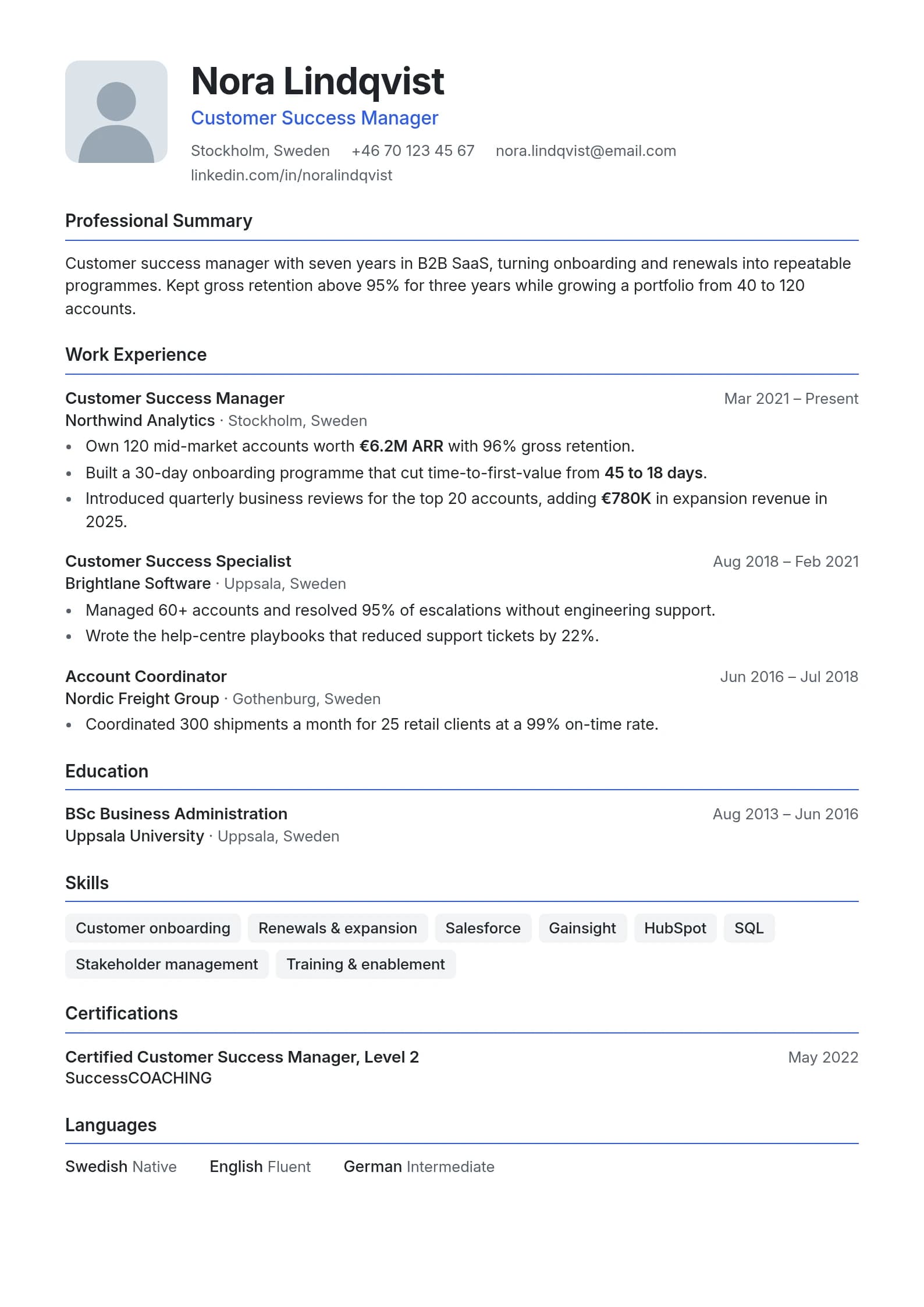
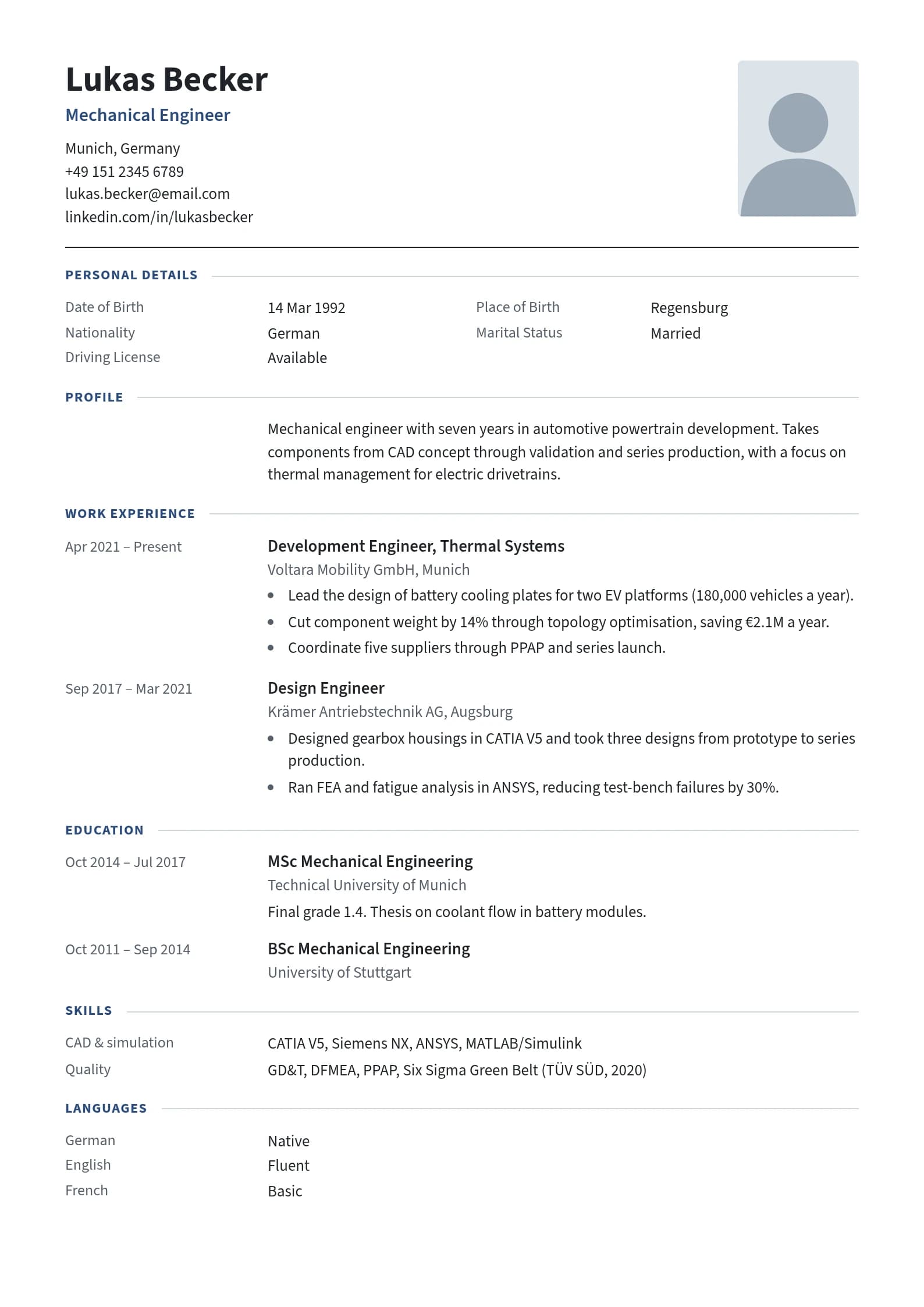
Every template is single-column and ATS-friendly
Browse All TemplatesFrequently Asked Questions
How do I explain a career change in my resume summary?
Name the target role first, state your real background in plain terms, and add one relevant proof point. Avoid phrases like "seeking to transition" and describe what you will do.
Should I remove unrelated experience?
Usually not. Gaps raise more questions than unrelated jobs. Shorten older, unrelated roles to a line or two and spend the space on relevant ones.
What resume format works best for career changers?
A combination format: summary, skills, then experience in reverse-chronological order. It puts relevance first without hiding your history.
Should I use a resume objective?
A short, specific objective-style opening can help when your titles do not match your target. A summary works better once you have relevant experience, projects or credentials.
Do I need a certification before changing careers?
Not always. Check three postings for your target role. If they list a credential as required, get it. If it is only preferred, a project can do the same job.
How long does a career change take?
It varies with the field, your starting skills and the job market, so plan for months and keep your current job while you build experience.
Can I change my job titles to match the new field?
No. Keep your real titles and dates. Add context in the bullets and the summary instead.
Key Takeaways
- Translate, don't start over. Reframe real experience in the target field's language.
- Lead with a target-role summary. State your real background and one proof point.
- Keep real titles, change the bullets.
- Use a combination format and mirror the posting's skills.
- Add proof with projects, volunteering or credentials.
- Say the change out loud in your cover letter and interviews, and use referrals.
Ready to start? Building in ResumeFast is free, and your first PDF or Word download is free. Paste in your current resume and rewrite the summary and bullets for the role you want.
Your resume is your first impression. Make it count.
Build an ATS-optimized resume that gets read, with AI help on every section.
No credit card required. Your first PDF or Word download is free; after that, Pro is $6.95 a month.
Continue Reading
View all articles
How to List Freelance Work on a Resume (With Examples)

Resume Gap or Career Break? How to Explain It

Skills-Based Resume: Format, Examples and When to Use It

Medical to Non-Medical Resume: Skills and Examples

Retail to Office Job Resume: Examples and Translation Guide

Malaysia Resume Format 2026: Sections, Rules and Sample
Build a resume that gets interviews
Ready to build your resume?