
Resume Tense: Past or Present? Rules for Every Section
Should a resume be in past or present tense? Present for work you still do, past for everything finished, even in your current job. Rules, examples and a table.

ResumeFast Team
The team behind ResumeFast

On this page
Build a resume that gets interviews
- ATS-optimized templates
- AI-powered writing
- Free to start
No credit card required
Use present tense for work you still do in your current job and past tense for everything that's finished: every previous job, and any completed project or result in your current one. Write the summary without "I", and keep each bullet in one tense.
That's the whole rule. The confusion comes from the current job, where "manage" and "managed" both sound right. They're both right, for different things: "manage" for the budget you still run, "managed" for the launch you finished in March. The rest of this page shows how to apply that in every section, what the data says people actually do, and the mistakes worth fixing.
The rule, section by section
| Where | Tense | Example |
|---|---|---|
| Current job, ongoing duty | Present | Manage a $1.2M paid search budget across Google and Microsoft Ads |
| Current job, finished result or project | Past | Cut cost per lead 31% in 2025 by rebuilding the bidding strategy |
| Every previous job | Past | Trained 14 new hires on the returns system |
| Job you've left but haven't updated | Past, and replace "Present" with the end date | Led the move to a new ERP system |
| Ongoing volunteer role or side business | Present for what continues | Coach a 12-player under-10 soccer team every season |
| Summary | Present, no pronouns | Payroll specialist with six years in multi-state payroll |
| Projects section | Past if finished, present if you still maintain it | Built a price tracker in Python; maintain it for 300 users |
| Skills section | No verbs | Excel (pivot tables, XLOOKUP), SQL, Tableau |
| Education in progress | "Expected" plus the date | Bachelor of Science in Nursing, Expected May 2027 |
University career centers state the basic split the same way. Georgetown's says to "use the past tense to describe past positions and the present tense for current positions", and UC San Diego's gives the same rule in its resume guide.
Your current job: present for the job, past for the results
A finished result is in the past even if you still work there. You don't "increase retention 18%" every day; you increased it once, last year. Writing it in present tense makes a one-time achievement sound like a routine duty, which undersells it.
So a current job usually mixes both:
Account Executive, Mid-Market | Peachtree People Software | Jan 2022 - Present
- Run full-cycle deals of $40K to $150K with HR, finance and IT buyers
- Closed $1.2M in new annual recurring revenue in 2025, 118% of quota
- Earned President's Club in 2023 and 2025
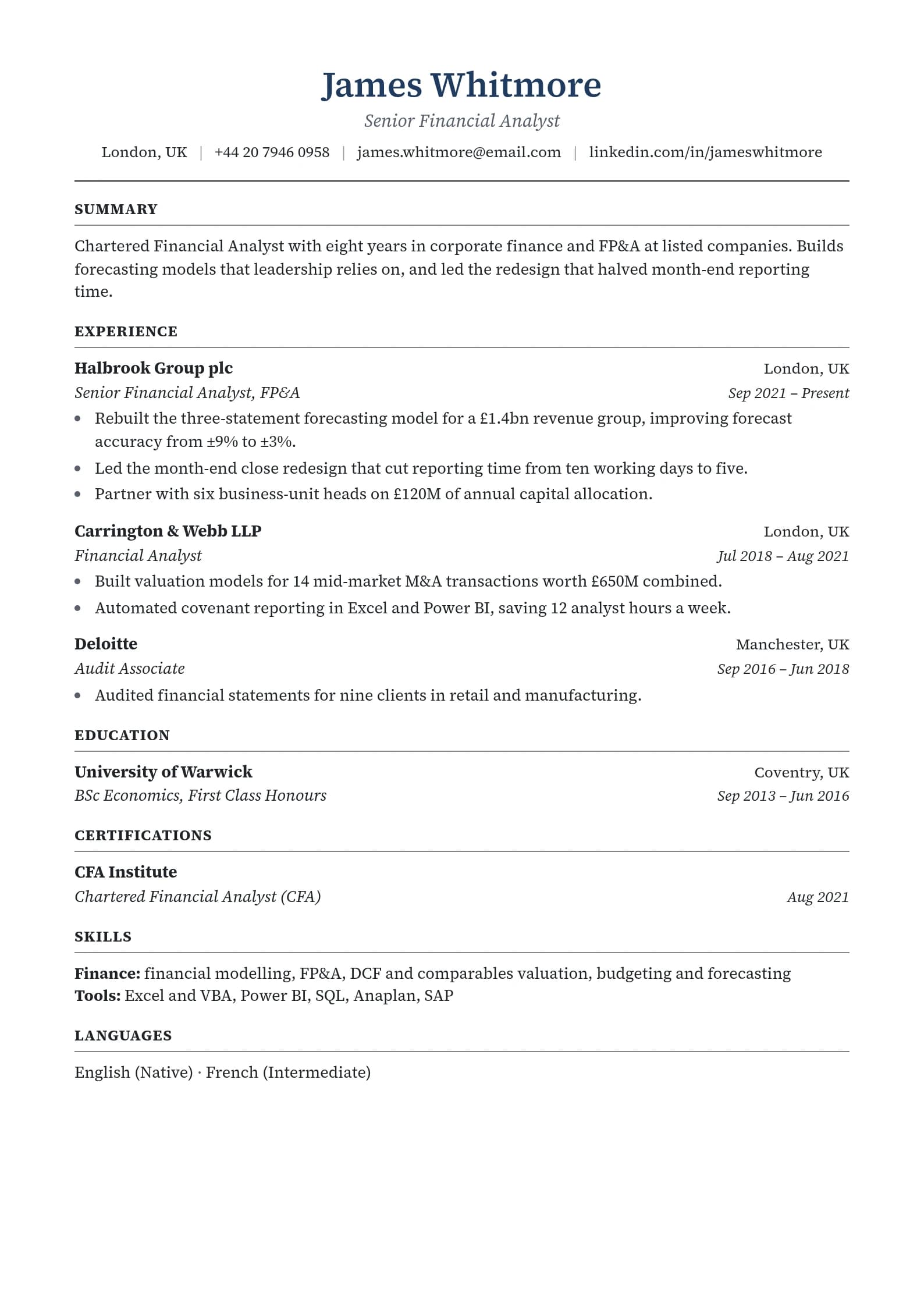
The first bullet describes the job as it is now. The other two are things that happened. That's the pattern on our sales representative resume example, and it's what Harvard's career office shows on its own sample resume: an executive committee role dated "February 2024 - Present" is described with "Organized" and "Coordinated", while a weekly commitment on the same page says "Commit 25 hours per week".
One test settles every bullet: is it still happening? If yes, present tense. If it happened and ended, past tense.
What people actually write
You may have read that every bullet in a current job must be present tense. Most resumes don't do that, and nothing suggests they suffer for it.
Simplify, a job search platform, analyzed 26,981 bullet points from resumes edited on its site in the twelve months to July 2026, classifying tense by each bullet's first word:
| Bullets under... | Open with a past-tense verb |
|---|---|
| A current role (6,305 bullets) | 76.9% |
| A past role | 88.5% |
Only 1.8% of current-role bullets opened with a third-person present verb such as "Manages", and 3.5% with an "-ing" word. Simplify notes two limits: the tense check is a heuristic on the first word, and its own builder drafts bullets that lean past tense, so treat the ratios as direction rather than precision. About a quarter of current roles with two or more bullets mixed past and present openers.
The takeaway: past tense in a current job is normal for finished work. The mistakes recruiters notice are the other ones: a job you left five years ago described in present tense, or one bullet that switches tense halfway through.
Does tense matter to an ATS?
Not much, for search. Jobscan says applicant tracking systems "have evolved to recognize variations of a word", so a recruiter's search for "management" can also find "manage" or "managed", in its article on resume tense. Vendors rarely publish exactly how their matching works, though, so don't rely on a verb form to carry a keyword.
The safe move is to put the posting's exact skill noun somewhere on the page: "Project management" in your skills, "managed" in a bullet. Paste the posting and your resume into the free keyword matcher to see which of its terms you're missing. Our ATS keywords guide covers the rest.
No "I", no "he", no "-ing"
Write bullets in implied first person: drop the "I" and keep the verb. "Manage the regional schedule" is "I manage the regional schedule" with the pronoun removed. MIT's career office says "you should avoid using the first person (I, me, my)", and Georgetown's says the same.
Two common slips follow from getting this wrong:
Third person reads like a job ad.
Before: Manages vendor contracts and reviews invoices
After: Manage vendor contracts and review invoices
"-ing" openers read like a list of activities.
Before: Handling customer escalations and training new agents
After: Handle customer escalations and train new agents (current job)
After: Handled customer escalations and trained 9 new agents (past job)
The same applies to "Responsible for": it hides the verb entirely. Our action verbs list has a strong opener for nearly every kind of work, and the bullet point formula shows how to add the result.
Three fixes worth making today
1. A bullet that switches tense.
Before: Manage the onboarding program and reduced first-month turnover by 20%
After, as two bullets, one for the duty and one for the result:
- Manage the onboarding program for every new hire
- Reduced first-month turnover by 20% in the program's first year
2. A past job still in present tense. This usually happens when you copy last year's resume and add a new job on top.
Before (job ended 2023): Supervise a team of six technicians
After: Supervised a team of six technicians
3. A summary written as a diary.
Before: I am a hardworking nurse who has worked in ICUs for many years
After: ICU nurse with eight years in cardiac and surgical intensive care, certified in critical care (CCRN)
The 60-second tense check
- Read only the first word of every bullet, from the top.
- Under your current job, ask of each one: is this still happening? Present if yes, past if no.
- Under every other job: all past tense, no exceptions.
- Check the dates: only one job (or two, if you hold two) should say "Present".
- Scan the summary for "I", "my" and "me" and cut them.
When you change jobs, update three things together: the old job's end date, its present-tense bullets and any summary line that still describes it as current.
Build it in ResumeFast
The ResumeFast builder prints "Present" for any job without an end date, and its Suggest bullets button drafts bullets for a role that you can edit into the right tense (it uses AI credits; a free account gets 10 a month). Building is free, and your first PDF or Word download is free. When you're done, run the file through the ATS checker to see how each section is read.
For what each job entry should contain beyond the verbs, see the work experience section guide.
Frequently Asked Questions
Should a resume be in past or present tense?
Both. Use present tense for duties you still perform in your current job and past tense for everything finished: all previous jobs and any completed results or projects in your current job.
Should my current job be in present tense on my resume?
Ongoing duties should be, such as Manage a team of five. Finished achievements in the same job take past tense, such as Cut onboarding time by 30% in 2025, because they already happened.
Is it OK to mix tenses in one job on a resume?
In your current job, yes: present for ongoing duties, past for completed results. Keep each individual bullet in one tense, and write every previous job entirely in past tense.
Should I use I or my on a resume?
No. Write bullets in implied first person, starting with the verb: Manage the regional schedule, not I manage the regional schedule. Career offices such as MIT's and Georgetown's advise against first-person pronouns.
What tense is a resume summary?
Present tense, without pronouns, because it describes who you are now: Payroll specialist with six years in multi-state payroll. Use past tense inside the summary only for a specific finished result.
ResumeFast Team
The team behind ResumeFast
The team that builds ResumeFast's resume templates and ATS checker and writes its expert reviews..
Want a person to read your resume?
With an Expert Review, a person reads your resume, comments on every section and ranks the fixes by impact. $29 once, usually back in 3 business days.
Build your resume first, then order the review from your dashboard. One time, on any plan.
Continue Reading
View all articles
How to List Awards and Honors on a Resume (With Examples)

How Far Back Should a Resume Go? Rules for Older Jobs

How to Show a Promotion on Your Resume (With Examples)

Resume Date Format: How to Write Employment Dates

Declaration in Resume: 8 Samples to Copy (and When to Skip)
