
Resume Experience Section: How to Write It (Examples)
How to write the experience section of a resume: the format for each job, what to write in bullet points, before-and-after examples, and tips for freshers.

ResumeFast Team
The team behind ResumeFast

On this page
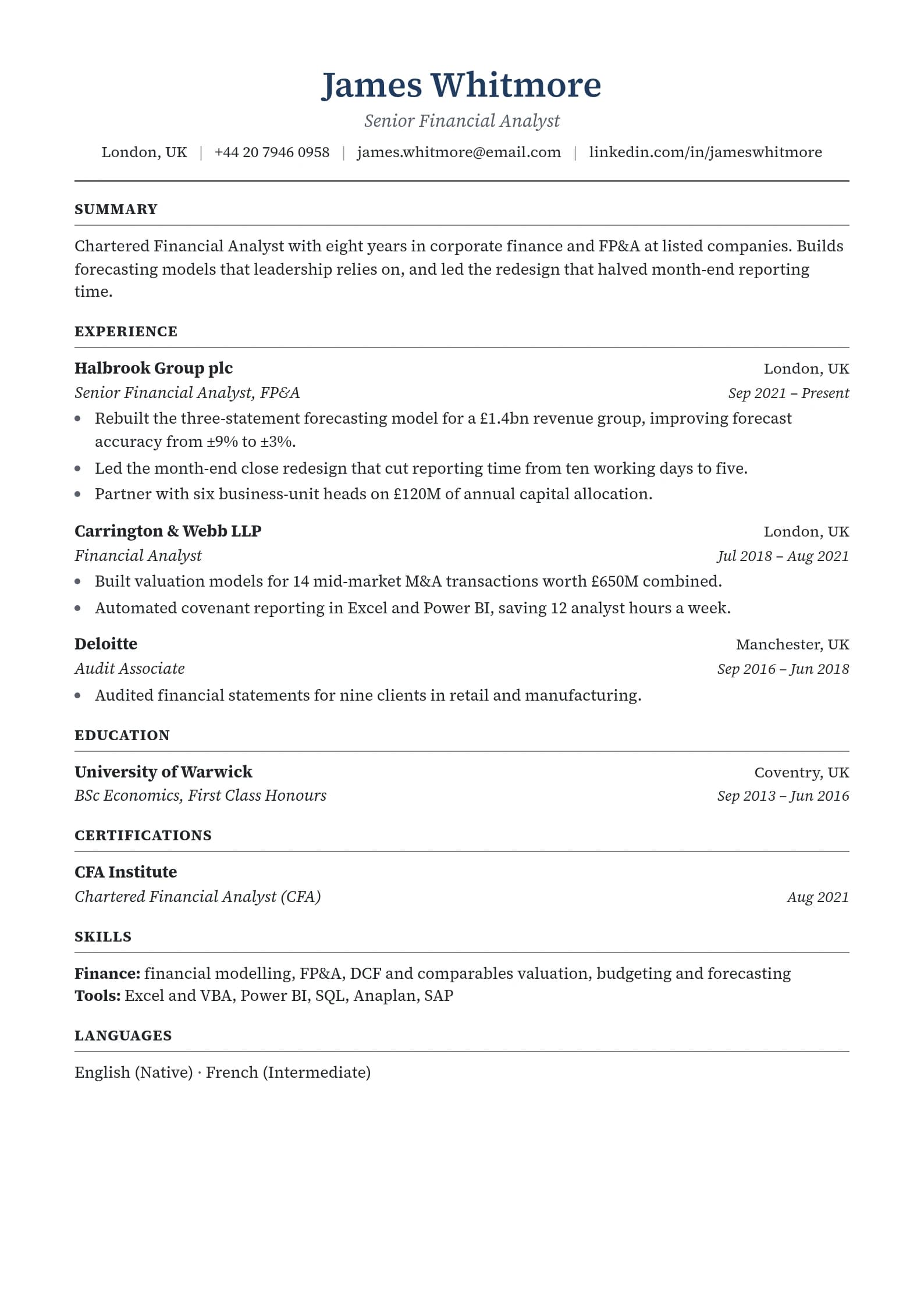
Build a resume that gets interviews
- ATS-optimized templates
- AI-powered writing
- Free to start
No credit card required
The experience section lists your jobs in reverse chronological order. Each entry gives your job title, employer, location and dates, followed by three to five bullet points that start with an action verb and show a result. It usually comes right after your summary, unless you're a student or changing careers.
It's also the section recruiters spend their time on. In The Ladders' eye-tracking research, recruiters spent an average of 7.4 seconds on an initial resume screen. A scan that fast picks up titles, employers, dates and the first words of a few bullets, so those are what this guide helps you get right.
The Format for Each Job
Use the same layout for every job so the reader's eye knows where to look:
Job Title | Employer, City, ST | Mon YYYY - Mon YYYY
- Action verb + what you did + the result
- Action verb + what you did + the result
- Action verb + what you did + the result
Senior Marketing Manager | Acme Corp, New York, NY | Jan 2023 - Present
- Launched a weekly video series that became the largest source of organic sign-ups within a year
- Rebuilt the email nurture sequence, lifting trial-to-paid conversion from 9% to 13%
- Hired and managed a team of three content marketers
Four rules for the layout:
- Reverse chronological order. Current or most recent job first.
- Bold the job title, since that's what the reader scans for.
- Month and year for dates, the same format everywhere.
- Three to five bullets for recent jobs, fewer for older ones.
What goes into each entry, and how far back to go, is covered in detail in how to list employment history on a resume.
What to Write in the Bullet Points
A good bullet says what you did and what changed because of it. A weak bullet copies your job description. Compare:
| Weak (a duty) | Strong (an achievement) |
|---|---|
| Responsible for social media accounts | Grew Instagram following from 5K to 28K in 12 months with a weekly video series |
| Worked on backend database optimization | Cut API response times by 65% by redesigning the query layer |
| Handled customer complaints and returns | Resolved 50+ customer issues a day and wrote the returns script the team adopted |
| Helped with onboarding new staff | Trained 12 new hires on the POS system, cutting their time to work solo from 3 weeks to 1 |
These are illustrations of the pattern, not benchmarks. Use your own real numbers.
A reliable pattern is the formula popularized by former Google HR chief Laszlo Bock: accomplished X, as measured by Y, by doing Z.
Reduced month-end close from 8 days to 5 (X, Y) by automating bank reconciliations in Excel Power Query (Z)
If you don't have exact metrics, use scale (team size, budget, number of clients), frequency (daily, per shift) or a before-and-after comparison. Our guide to quantifying achievements without numbers has a cheat sheet for every job type, and the action verbs list gives you better openings than "Responsible for".
Want a second opinion on a draft bullet? Paste it into the free bullet point grader.
More Before-and-After Examples
Customer service representative
Before:
Answered phones and helped customers with their accounts
After:
Handled 60+ inbound calls per shift for a 40,000-customer utility, keeping a first-call resolution rate above the team target for 11 straight months
See a full page built this way in the customer service representative resume example.
Project coordinator
Before:
Coordinated meetings and tracked project tasks
After:
Ran weekly status meetings for a 14-person software rollout across 3 offices, flagging two vendor delays early enough to keep the launch date
Warehouse associate
Before:
Picked and packed orders
After:
Picked and packed 180 orders per shift at 99.8% accuracy; trained 4 seasonal hires on the scanner workflow
Where the Experience Section Goes
| Your situation | Section order |
|---|---|
| Two or more years of relevant work | Summary, Experience, Skills, Education |
| Student or recent graduate | Summary, Education, Experience (internships, part-time), Projects, Skills |
| Career changer | Summary, Skills, Projects or training, Experience |
If you're changing fields, a hybrid layout that leads with skills can work better. See the skills-based resume guide for when it helps and when it backfires.
Work Experience for Freshers and Students
If you have little paid work in your field, your experience section can still hold real experience. Internships count most: in NACE's Job Outlook 2026 survey, employers named an internship with their organization or in their industry as the two factors with "very much influence" when choosing between otherwise equal graduates. Include:
- Internships, paid or unpaid
- Part-time and summer jobs, even outside your field: they show reliability, customer contact and time management
- Freelance or contract work
- Volunteer roles with clear responsibilities
- Campus leadership with real duties, such as running a club budget or organizing events
Format them exactly like full-time jobs. For a "Barista" role, write about speed, cash handling and training new staff. If you have almost nothing to list, our guide to writing a resume with no work experience shows how projects and coursework can carry the page.
For how this section fits with the summary, skills and education, see the resume writing guide.
Five Mistakes That Weaken the Experience Section
- Copying the job description. It tells the reader what you were supposed to do, not what you did.
- Starting bullets with "Responsible for" or "Helped with". Start with the verb that describes your part.
- Listing every job you've had. A summer job from 2009 doesn't help a senior application.
- Using the same bullets for every application. Reorder them so the ones closest to the posting come first.
- Long bullets. If a bullet runs past two lines, split it or cut words.
Frequently Asked Questions
What should I write in the work experience section of a resume?
For each job, write your title, employer, location and dates, then three to five bullet points. Each bullet should start with an action verb and show a result, such as time saved, revenue, customers served or a process you improved.
How many jobs should I list in my experience section?
Enough to cover the last 10 to 15 years of relevant work. Early-career candidates can list every relevant job, internship and part-time role; experienced candidates can shorten or drop older ones.
Should I include short-term jobs?
If a job lasted only a few months and isn't relevant, you can leave it off a resume. Include it if it's relevant or if leaving it off would create a gap you would rather not explain.
How do I show a promotion in my experience section?
List the employer once and stack each title underneath with its own dates and bullets. This shows growth without repeating the company name.
What if I have no work experience?
Use internships, part-time jobs, volunteer roles, freelance work and substantial projects. Format them like regular jobs, with dates and achievement bullets.
ResumeFast Team
The team behind ResumeFast
The team that builds ResumeFast's resume templates and ATS checker and writes its expert reviews..
Your resume is your first impression. Make it count.
Build an ATS-optimized resume that gets read, with AI help on every section.
No credit card required. Your first PDF or Word download is free; after that, Pro is $6.95 a month.
Continue Reading
View all articles
How to List Certifications on a Resume (25+ Examples)

How to List Contract Work on a Resume (With Examples)

Declaration in Resume: 8 Samples to Copy (and When to Skip)

Career Objective for Freshers: 60+ Examples to Copy (2026)

Resume for Freshers: Format, Skills and Examples (2026)

Hobbies and Interests on a Resume: When and How (Examples)
Build a resume that gets interviews
Ready to build your resume?