
How Long Should a Resume Be? One Page vs. Two (2026)
How long should a resume be? One page or two by career stage, what recruiter research and career offices say, when three pages is fine, and how to cut it down.

Raman M.
Software Engineer & Founder of ResumeFast

On this page
Build a resume that gets interviews
- ATS-optimized templates
- AI-powered writing
- Free to start
No credit card required
A resume should be one page if you have less than about five years of relevant experience, and up to two pages if you have more and every line earns its place. Senior executives, academics and some federal applicants follow different rules. Never shrink fonts below 10 points or margins below half an inch to force one page: cut words instead.
The "one page, always" rule made sense for students, and it still does. Applied to everyone, it pushes experienced candidates to cut the evidence that would get them hired.
Resume Length by Career Stage
| Career stage | Target length | What fills it |
|---|---|---|
| Student or new graduate (0-2 years) | 1 page | Education, 1-2 internships, projects, skills |
| Early career (2-5 years) | 1 page | 2-3 jobs with strong bullets, short education |
| Mid-career (5-15 years) | 1-2 pages | 3-5 jobs, more detail on recent ones |
| Senior (15+ years) | 2 pages | Last 10-15 years in detail, earlier roles summarized |
| Executive / C-suite | 2, occasionally 3 | Scope, results, board roles |
| Academic CV | No fixed limit | Publications, grants, teaching |
| US federal (USAJOBS) | 2 pages maximum | Required details for each job |
How much of your history to include is a separate question; see how much work history to put on a resume.
What the Research Says
University career offices still teach one page for students. MIT's career office, for example, asks students to keep it to one page and allows two pages only for those with an advanced degree or extensive experience (10+ years).
Recruiters don't penalize two pages for experienced candidates. In an experiment by the resume service ResumeGo, 482 hiring professionals reviewed resumes for sample job openings in which only the length varied. Overall, they were 2.3 times as likely to prefer two-page resumes over one-page versions, 1.4 times for entry-level roles and 2.9 times for managerial roles. That is a stated preference in a simulation, not a count of real callbacks, but it points the same way as most recruiter advice: length isn't the problem, empty length is.
Some employers set hard limits. Since September 27, 2025, US federal applications through USAJOBS have been limited to two pages, and a longer resume can make you ineligible. If a posting states a limit, it overrides everything here. See the federal resume guide for that format.
When One Page Is Right
- Less than about five years of relevant experience
- Students, new graduates and most internship applications
- Career changers whose older experience doesn't support the new role
- Roles where brevity is expected, such as some creative and startup jobs
When Two Pages Is Right
- Five or more years of relevant experience with achievements worth showing
- Technical roles where the depth of tools and projects matters
- Management roles where team size, budget and scope need space
- Any time you'd otherwise cut quantified results to make one page
Three pages is rare and reserved for C-suite executives with board roles, academics, and some specialist medical or research positions.
The Cost of Forcing One Page
When an experienced candidate squeezes onto one page, the first things cut are the numbers that prove impact, then whole jobs that showed progression.
Before (one page for a 12-year engineering manager):
Senior Engineering Manager, Acme Corp (2020 - Present)
- Manage engineering teams across multiple product lines
- Drive technical strategy and architecture decisions
Engineering Manager, Beta Inc (2016 - 2020)
- Led backend engineering team
(Two earlier roles cut to fit)
After (two pages, same person):
Senior Engineering Manager, Acme Corp (2020 - Present)
- Manage 4 engineering teams (32 engineers) across payments, identity and platform
- Cut system downtime sharply through an architecture overhaul, saving an estimated $1.8M a year
- Promoted 6 engineers to senior roles; built a new mobile team from scratch
Engineering Manager, Beta Inc (2016 - 2020)
- Grew the backend team from 3 to 14 engineers through two funding rounds
- Shipped a real-time analytics pipeline processing 500M events a day
Senior Software Engineer, Gamma Labs (2014 - 2016)
- Technical lead on a recommendation engine that raised engagement 28%
Software Engineer, Delta Tech (2012 - 2014)
- Built a payment integration handling $40M in annual transactions
The one-page version reads mid-level. The two-page version reads senior. The figures are illustrations; yours must be real.
The Cost of Padding to Two Pages
The opposite mistake signals that you can't tell what matters.
Before (two pages for a two-year career): seven duty bullets for the current job, three for an internship, eight lines of coursework and high school volunteering on page two.
After (one focused page):
Marketing Coordinator, StartupX (2024 - Present)
- Grew company Instagram from 800 to 4,200 followers in 8 months
- Created an email series that generated 340 marketing-qualified leads
Marketing Intern, AgencyY (2023 - 2024)
- Managed the social content calendar for 3 clients
B.S. Marketing, State University (2023) Skills: HubSpot, Google Analytics, Figma, Meta Ads Manager
Does Resume Length Affect ATS Screening?
No. Applicant tracking systems read the text of every page; they don't stop at page one. What causes parsing problems is formatting (text boxes, headers and footers, images), not length. A second page can even help, because it gives you room to describe tools and skills a recruiter may search for. The resume formatting guide covers the layout rules that do matter.
Make Every Line Earn Its Place
The real test is value per line, not page count.
The "so what?" test. Read each bullet and ask why an employer would care. "Managed a team of engineers" fails. "Led a 12-person team that shipped three weeks early" passes.
Taper the detail. The newest job gets the most bullets:
- Current role: 4 to 6 bullets
- Previous role: 3 to 5 bullets
- The one before: 2 to 4 bullets
- Older roles: 1 to 2 bullets, or a single "Earlier career" line
Our guide to how many bullet points per job explains how to budget them.
Cut repeats. If two bullets prove the same skill, keep the stronger one.
Resume vs. CV Length
- Resume: one to two pages, occasionally three for executives. Used for most private-sector jobs in the US and Canada.
- Academic CV: no page limit; a full record of publications, grants, presentations and teaching.
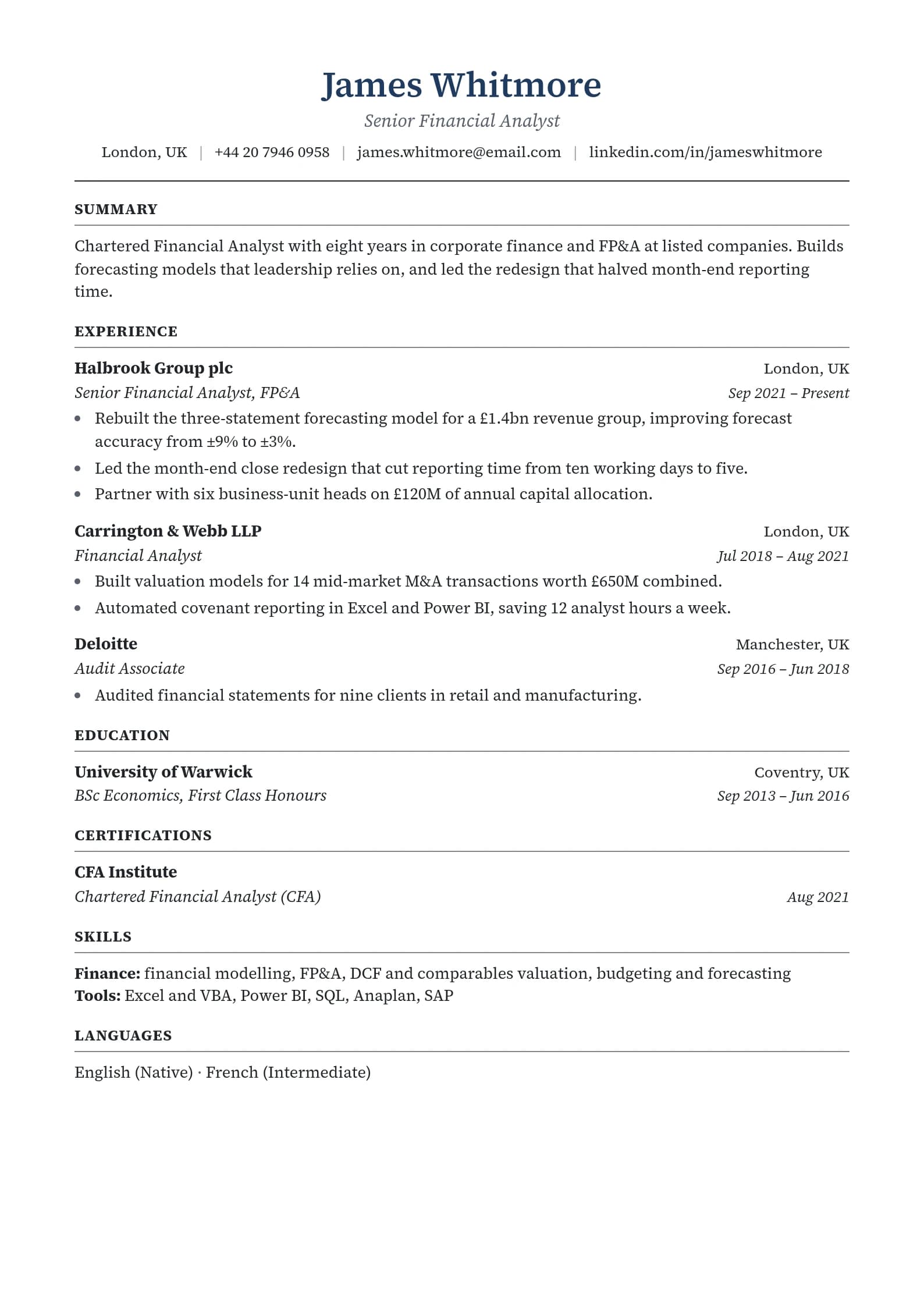
- CV outside North America: in the UK, Ireland and much of Europe, "CV" usually means what Americans call a resume, typically two pages.
A Four-Step Decision Process
- Write without a limit. Include everything relevant.
- Cut with the "so what?" test. Remove every bullet a hiring manager wouldn't ask about.
- Check where you land. One full page or close to two full pages are both fine.
- Avoid the awkward middle. A second page with three lines on it looks unfinished. Tighten to one page or add substance.
For the rest of the page, see the resume writing guide. In ResumeFast's resume builder, the live preview shows how many pages your resume runs to as you type, so you can see where you land.
Frequently Asked Questions
How long should a resume be?
One page for students and candidates with less than about five years of experience; up to two pages for experienced candidates when every line adds value. Executives and academics can go longer, and US federal resumes are limited to two pages.
Is a two-page resume okay?
Yes, if you have enough relevant experience to fill it with results. A full two-page resume beats a cramped one-page version that cuts your best evidence.
Should a new graduate's resume be one page?
Yes. With less than two years of experience, one page is expected, and a second page usually signals padding.
Do recruiters read the second page?
If the first page earns their interest. The first page should carry your strongest, most recent evidence; the second page supports it with earlier roles and detail.
Does resume length affect applicant tracking systems?
No. ATS software reads the text on every page. Formatting choices such as text boxes, headers and images cause parsing problems, not length.
How long should a CV be?
An academic CV has no page limit. In the UK and much of Europe, where CV means a standard job application document, two pages is typical.
Your resume is your first impression. Make it count.
Build an ATS-optimized resume that gets read, with AI help on every section.
No credit card required. Your first PDF or Word download is free; after that, Pro is $6.95 a month.
Continue Reading
View all articles
How to Format a Resume: Fonts, Margins and Layout

Career Objective for Freshers: 60+ Examples to Copy (2026)

Resume for Freshers: Format, Skills and Examples (2026)

Job Hopping on a Resume: How Short Tenures Read in 2026

How to Turn an Internship Into a Full-Time Job (2026)

Portfolio vs Resume: When You Need Both (Creative Jobs)
Build a resume that gets interviews
Ready to build your resume?