
Letter of Interest for an Internal Position: 4 Examples
How to write a letter of interest or expression of interest for an internal job, promotion or transfer, with four full examples to copy and an email version.

Raman M.
Software Engineer & Founder of ResumeFast

On this page
Build a resume that gets interviews
- ATS-optimized templates
- AI-powered writing
- Free to start
No credit card required
A letter of interest for an internal position is a short email or letter to a manager at your own company saying you want to be considered for a role, promotion or transfer, and why you would be good at it. An expression of interest is the same document under a different name. Keep it under 300 words and end by asking for a conversation, not for the job.
This guide gives you the structure, four complete examples (a promotion, a move to another department, a posted job and a role that does not exist yet) and the follow-up emails. Every sample below is written to be copied: swap the names, the role and the numbers for your own. The figures in the samples are placeholders, so replace them with results you can prove.
Letter of interest vs expression of interest vs cover letter
These three get mixed up, and the mix-up is why most internal letters read wrong.
| Letter of interest / expression of interest | Internal cover letter | |
|---|---|---|
| When | No posting yet, or you want to be on the list early | A posted internal job with an application |
| Who asked for it | Nobody. You are starting the conversation | The application form or the hiring manager |
| Main job | Get a conversation and get your name in the room | Win an interview for a specific posting |
| Typical length | 150 to 300 words | 250 to 400 words |
| Closing ask | A 15 to 20 minute chat | An interview |
"Expression of interest" (often shortened to EOI) is the more common phrase in the UK, Australia, New Zealand and in public sector and university jobs. Some employers run it as a formal step: a short written EOI that managers use to build a shortlist, sometimes with a few questions to answer. If your employer has a form, fill it in and use the examples below as the wording for each box.
If a posting exists and you are applying for it, write the internal cover letter instead. It covers promotions and lateral moves, and it has its own examples.
Why internal mobility is worth the awkward email
LinkedIn's Workplace Learning Report found that at the two-year mark, an employee who has made an internal advancement is almost 20% more likely to stay with the organization than one who has not (LinkedIn, career pathing and employee retention). Managers know this, which is one reason a clear internal request is usually welcome rather than rude.
When a letter of interest makes sense
- A role is about to open. A resignation, a restructure or a headcount approved in the budget. Your note lands before the job description is written.
- A team is growing and you want in. A new client, product or office means new roles are coming.
- You want to propose a role. You have been doing part of a job nobody owns and can show the work.
- You are ready for the next level before the cycle. Many promotions are discussed before they are posted. Your manager should hear it from you first. The internal promotion cover letter guide covers the full sequence once the role is posted, including the interview.
Tell your current manager before you write to anyone else. Hearing about it second, from someone else, is the one thing that turns an ambitious email into a trust problem.
The four-part structure
- Name the opportunity (1 to 2 sentences). Say the role or team and why you are writing now, so the reader is not guessing.
- Show two or three results (3 to 5 lines). Pick results that match the role. Use numbers you can defend if someone asks.
- Show you have thought about the role (2 to 3 sentences). What would you work on first? This is what separates a letter of interest from a cover letter.
- Ask for a conversation (1 to 2 sentences). Offer a time window. Do not ask for a decision.
Example 1: Promotion to team lead (no posting yet)
A senior designer writes to a VP after hearing that a design lead role might open.
Subject: Interest in the Design Lead role
Hi Claire,
After our planning conversation, where you mentioned adding a Design Lead for the product group, I would like to be considered for it.
In the past two years I have taken on work that sits at lead level:
- Led the design system rebuild that cut design-to-dev handoff from 5 days to 2 across three product teams.
- Mentored two junior designers through their first year.
- Started a weekly design and engineering review that moved UX issues earlier in each sprint.
If the role goes ahead, I would start with three things: one shared critique process so quality is consistent across squads, a reusable component library to stop the duplicate work between teams, and a clear growth path for individual contributors so we keep the people we train.
Could I take 15 minutes of your time next week to talk it through? I am flexible on timing.
Thanks, Claire. Jordan
Why it works: Jordan does not ask for a promotion. Jordan shows lead-level work already happening, shows a plan, and asks for 15 minutes.
Example 2: Move to a different department
An operations coordinator writes to a product director. There is no open product role.
Subject: Exploring a move into product
Hi David,
I wanted to share something directly instead of waiting for a posting. The projects I enjoy most and have had the most impact on sit between operations and product, and I would like to move in that direction.
- I led the vendor onboarding redesign with your PM team, which took onboarding from 14 days to 5.
- I built the fulfillment dashboard that operations and product now both use every day.
- I grouped 400 survey responses into themes that fed two items on the current roadmap.
I am not asking you to create a role. If a headcount, a rotation or a hybrid arrangement ever makes sense, I would like to be part of that conversation. I also think the handoff between ops and product loses customer insight, and a person who has worked both sides could fix part of that.
Would you be open to a coffee chat in the next couple of weeks?
Thanks, David. Priya
Why it works: She names the unusual nature of the request, gives David several ways to say yes (headcount, rotation, hybrid) and ties her ask to a problem he already has.
Example 3: A job posted inside the company (short email)
If the role is posted and you want the hiring manager to hear from you before the application lands, this is a "letter of interest for a job within the same company" in its shortest form.
Subject: Applying for Marketing Analyst, a quick note first
Hi Sarah,
I saw the Marketing Analyst posting and I am applying today. Before I do, I wanted you to hear it from me.
For the last two years on the finance team I built the monthly channel report that marketing now uses for budget calls, so I already know your data, your tools and the questions leadership asks. I have also been learning SQL in the evenings and can show you a dashboard I built on your campaign data.
Do you have 15 minutes this week for me to ask what you need most from this hire?
Thanks, Alex
Why it works: It is five sentences, it names the posting, it offers proof the manager can check, and it asks a question about the manager's needs instead of repeating the resume.
Example 4: An expression of interest for a formal EOI process
Some employers ask for a written expression of interest with a word limit. Treat each sentence as an answer to "why you, why this, why now".
Expression of interest: Senior Project Officer, Infrastructure Delivery
Why I am interested (60 words). I have worked on infrastructure delivery for four years, most recently as project officer on the regional roads program. I want to move to the senior role because it carries the contract management I have been doing informally while the senior post was vacant.
What I bring (80 words). I manage a 14-contract register, prepare monthly variation reports for the steering committee and mentor two graduates. I have completed the project management certificate and I am familiar with the procurement framework this team works within.
What I would focus on (50 words). Clearing the backlog of unapproved variations in the first quarter, and setting up one shared register so contract changes are visible to everyone who needs them.
Why it works: Headings match the questions a panel scores. The language is plain and every claim can be checked against the work.
Before and after: a weak letter, fixed
Before:
Hi Sarah, I am writing to express my interest in any upcoming opportunities on the marketing team. I have been with the company for three years and I am looking for a new challenge. I am a hard worker and a team player. Please let me know if anything opens up.
What is wrong: No role. No proof. No plan. All of the work is pushed to Sarah.
After:
Hi Sarah, after seeing the Q4 launch results I have been thinking about how my analytics background could support the marketing team's move into data-driven content. I built the attribution model that showed which three channels convert best, which led to a budget shift the team still uses. If there is room for a marketing analytics role, I would start with a live content dashboard and an A/B testing routine for email. Could we talk for 15 minutes in the next two weeks?
Follow-up emails that do not feel pushy
Send the first follow-up after 5 to 7 working days. Keep it to two sentences.
Hi Claire, following up on my note about the Design Lead role. No rush at all, and I am happy to talk whenever it suits you.
If there is still no answer, wait two weeks and send one last line:
Hi Claire, one last nudge in case this slipped by. If the timing is wrong I understand, and I would be glad to pick it up later.
After that, stop emailing and raise it in your next one-to-one or team planning meeting. If a manager sends you to HR or to a formal application, follow that path. For follow-up wording that applies to external applications, see follow-up emails by timing.
Get the supporting documents ready
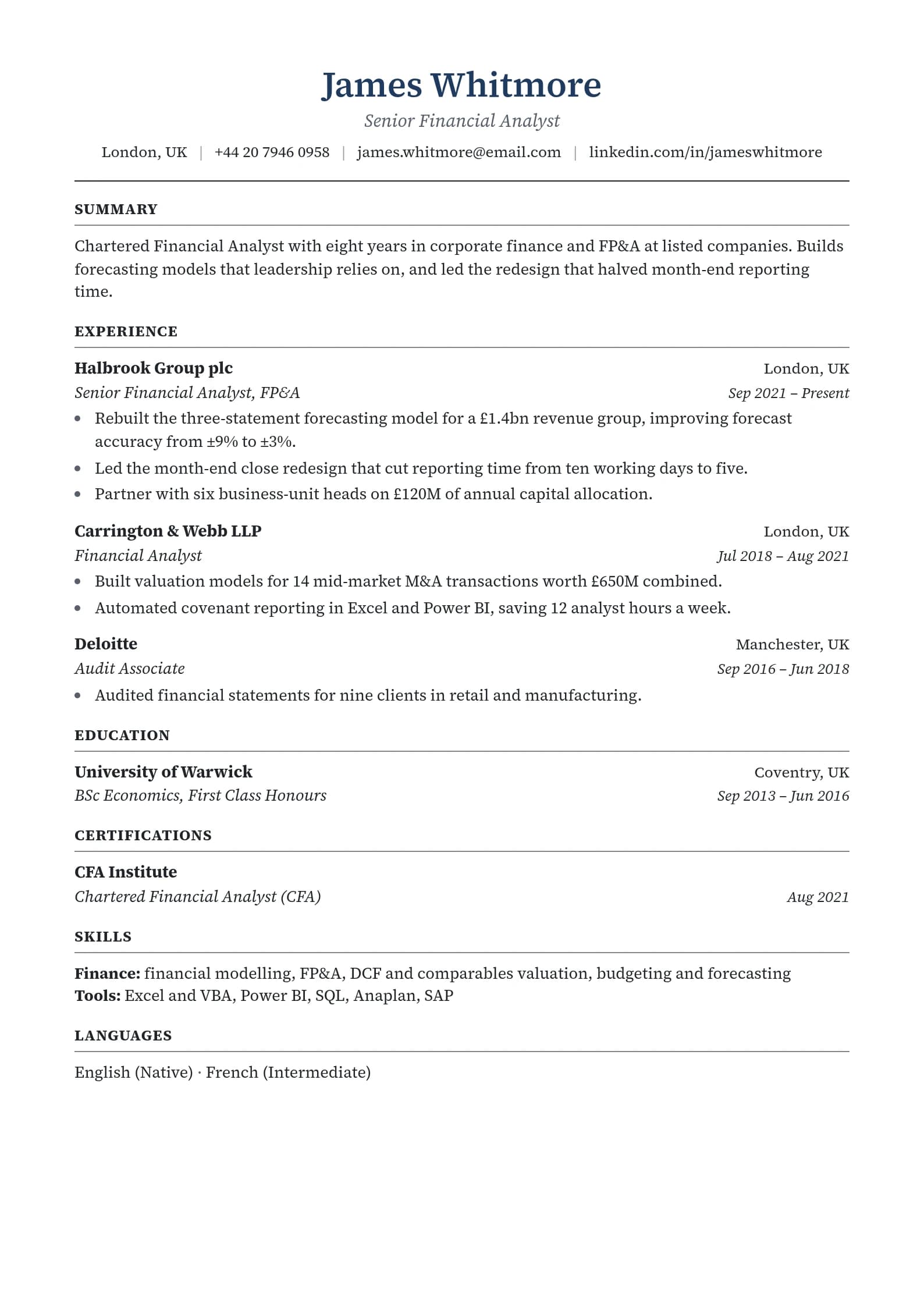
When the conversation goes well, the next request is your resume. Have an up-to-date one that leads with the results the role needs. ResumeFast's Cover Letter Generator can draft a first version of your letter in the right tone. You can build it free, and your first PDF or Word download is free, once per account; plain text (.txt) downloads are always free. After that, PDF and Word need Pro at $6.95 a month, billed monthly, with no trial, and you can cancel anytime. Check your resume against the posting with the ATS checker and the keyword matcher. The cover letter guide covers the fundamentals.
Frequently Asked Questions
What is the difference between a letter of interest and a cover letter?
A cover letter answers a posted job and argues you meet its listed requirements. A letter of interest is sent when there is no posting, or before you apply, to say you want to be considered and to start a conversation. An expression of interest is another name for a letter of interest.
How long should a letter of interest for an internal position be?
Aim for 150 to 300 words, which is about one screen of email. If you need more, the extra detail belongs on your resume or in the conversation you are asking for.
Who should I send it to, my manager or the hiring manager?
Tell your current manager first. Then send the letter to the manager of the team you want to join. If you want a promotion on your own team, your manager is the right recipient.
Can I send a letter of interest if there is no open role?
Yes. Frame it as interest and a conversation, not a demand. You are letting the manager know you are available and what you can do, so your name comes up when a role is discussed.
What if I get no reply?
Follow up once after 5 to 7 working days and once more after two weeks. After that, raise it in person at a one-to-one. Silence usually means not now, not no.
Is email the right format?
For internal requests, yes. Use a clear subject line such as Interest in Design Lead role. A formal letter on letterhead feels out of place unless your employer's process asks for one.
Your resume is your first impression. Make it count.
Build an ATS-optimized resume that gets read, with AI help on every section.
No credit card required. Your first PDF or Word download is free; after that, Pro is $6.95 a month.
Continue Reading
View all articles
Cover Letter for Internal Position or Promotion (Examples)

Two Weeks Notice Letter: 6 Samples You Can Copy

How to Spot a Fake Job Posting: 2026 Scam Red Flags

Career Objective for Freshers: 60+ Examples to Copy (2026)

Resume for Freshers: Format, Skills and Examples (2026)

Should You Apply for Jobs You're Not Qualified For?
Build a resume that gets interviews
Ready to build your resume?