High School Grads Are Getting Hired Faster. Why?
Federal Reserve data shows college graduates now spend more time unemployed than high school grads. Here's what the data reveals and what it means for your career.

Raman M.
Software Engineer & Career Coach
On this page
Build a resume that gets interviews
- ATS-optimized templates
- AI-powered writing
- Free to start
No credit card required
Here's a statistic that would have seemed impossible ten years ago:
According to Federal Reserve data, workers with only a high school diploma now find jobs faster than college graduates.
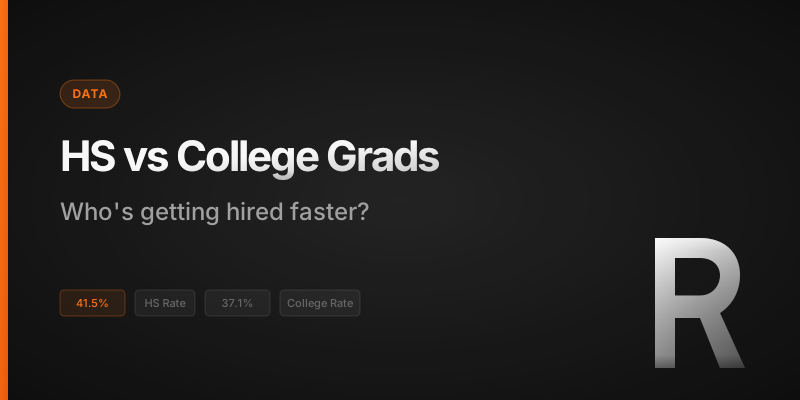
The job-finding rate for college graduates has dropped to 37.1%. For high school graduates with no college? 41.5%.
The gap between college and non-college worker unemployment has shrunk to its narrowest point in 30 years. The "college premium" that once justified student loans and four years of opportunity cost is evaporating in real-time.
This isn't a temporary blip. Understanding why reveals important truths about the 2026 economy and how to navigate it.
The Data That Challenges Everything
The Federal Reserve Bank of Cleveland published research in late 2024 that should have been front-page news. Key findings:
Job-finding rates:
- High school only: 41.5%
- Some college: 38.9%
- Bachelor's degree or higher: 37.1%
For the first time in modern tracking, less education correlates with faster employment.
Unemployment duration: College graduates now average longer periods of unemployment between jobs than workers without degrees. The credential that was supposed to provide stability and opportunity appears to be doing neither.
The shrinking gap: Throughout the 1990s and 2000s, college graduates had unemployment rates roughly 2-3 percentage points lower than high school grads. That gap has compressed to nearly nothing.
These aren't one-time anomalies. They represent structural changes in who employers actually want to hire.
What's Actually Happening
Three forces explain why employers increasingly favor workers without college degrees:
1. Skilled Trades Face Severe Shortages
The construction industry alone needs 500,000 additional workers in 2025, according to Associated Builders and Contractors. Electricians, plumbers, HVAC technicians, welders, and carpenters are in critical demand.
Baby boomers in these fields are retiring. Few young people replaced them. Decades of "college for everyone" messaging steered potential tradespeople toward office jobs.
The result: companies in skilled trades will hire anyone with basic aptitude and train them. They can't afford to be picky because qualified workers don't exist.
Meanwhile, white-collar employers receive hundreds of applications for each position and can demand extensive credentials.
2. AI Targets White-Collar Work First
Blue-collar automation happened in manufacturing decades ago. Today's AI revolution disproportionately affects knowledge work.
Think about what AI does well:
- Process information
- Generate text and content
- Analyze data
- Handle routine cognitive tasks
- Answer questions from knowledge bases
Now think about what AI cannot do:
- Install an electrical panel
- Repair a leaking pipe
- Build a deck
- Fix an HVAC system
- Weld structural steel
The jobs most resistant to AI automation are physical, hands-on work that requires presence, dexterity, and real-world problem-solving. These happen to be jobs that don't require college degrees.
3. Credential Inflation Priced Out Entry-Level
When companies required degrees for jobs that don't actually need them, they created artificial barriers. A customer service role doesn't require four years of higher education, but many companies require degrees anyway.
The economic logic is breaking down. Employers are discovering that degree requirements filter out capable candidates while not actually predicting job performance.
States like Maryland, Pennsylvania, and Colorado have removed degree requirements from many state jobs. Major employers like Google, Apple, and IBM no longer require degrees for many positions.
The degree isn't becoming worthless, but it's becoming less necessary as a default requirement.
What This Means for Career Planning
If you already have a degree, this data doesn't mean you wasted your time. It means you need to compete on factors beyond the credential.
If you don't have a degree, you have options you might not have considered.
For College Graduates: Compete Differently
Your degree puts you in a large pool competing for shrinking opportunities. Standing out requires:
Demonstrated skills over claimed credentials: A portfolio beats a diploma. A side project beats a GPA. Specific, measurable accomplishments beat general education.
Targeting the right employers: Large corporations with automated HR departments will filter heavily on credentials. Small and mid-sized companies often care more about what you can do than where you studied.
Considering adjacent paths: The direct path into your target career might be closed. Adjacent roles in target companies, related industries, or unexpected starting points might work better.
Being willing to start unconventionally: Freelance work, contract positions, or roles in smaller organizations build real experience even if they don't match the career path you imagined.
For Non-College Job Seekers: Explore Your Options
If you're considering whether college makes sense, or if you skipped college and wonder about your options, the data suggests more possibilities than you might assume.
Skilled trades: Electrician, plumber, HVAC technician, carpenter, welder. These careers offer:
- Apprenticeships that pay while you learn
- High earning potential (experienced tradespeople often earn $60,000-$100,000+)
- Job security from persistent labor shortages
- Work that can't be automated or offshored
- Physical activity and variety vs. desk work
- Business ownership opportunities
Healthcare support: Medical assistants, patient care technicians, pharmacy technicians, health information technicians. Healthcare faces chronic staffing shortages and provides extensive on-the-job training.
Technology adjacent roles: IT support, network technicians, cybersecurity analysts. Many tech roles value certifications and demonstrated skills over degrees.
Logistics and operations: Supply chain management, warehouse operations, fleet logistics. E-commerce growth created massive demand for operational talent.
Sales: Companies care about results, not credentials. If you can sell, you can earn well without a degree.
The Skills That Transfer Regardless of Path
Whether you have a degree or not, certain skills matter in every field:
Communication
Clear writing and speaking. The ability to explain complex ideas simply. Understanding your audience and adjusting accordingly.
Problem-Solving
Breaking down complex problems. Finding root causes. Proposing solutions. Adjusting when things don't work.
Reliability
Showing up consistently. Meeting deadlines. Doing what you said you'd do. This sounds basic, but it's genuinely rare.
Learning Ability
Picking up new skills quickly. Adapting to new tools and processes. Staying current in a changing field.
Relationship Building
Getting along with colleagues. Building trust with clients. Networking effectively. Work is collaborative, and difficult people struggle regardless of skills.
Trades: A Deeper Look
For readers seriously considering trades, here's a more detailed picture:
The Economics
An apprentice electrician might earn $30,000-$40,000 while training, instead of paying $40,000+ for college tuition. After 4-5 years of apprenticeship, a licensed electrician earns $55,000-$85,000 on average, with top earners exceeding $100,000.
Compare that to a college graduate who took loans and enters the job market competing for $45,000 entry-level positions.
The trades path often leads to higher net worth faster because you're earning and learning simultaneously rather than paying for education.
The Work
Trade work is physically demanding but mentally engaging. You solve real problems, see tangible results, and work in varied environments.
The stereotype of blue-collar work as mindless labor doesn't match modern reality. A skilled electrician troubleshooting a commercial electrical system uses significant analytical thinking. A plumber designing a residential system needs real engineering knowledge.
The Lifestyle
Work schedules vary. Some trades work 9-5. Others involve early mornings, evening calls, or seasonal intensity. Physical demands can be significant but vary by specialty.
The trade-off versus office work: physical demands instead of sedentary health risks, varied locations instead of fluorescent-lit offices, tangible accomplishments instead of abstract deliverables.
The Path
Most trades follow an apprenticeship model:
- Pre-apprenticeship (optional): Trade schools or community college programs teach basics
- Apprenticeship (3-5 years): Paid on-the-job training under experienced workers
- Journeyman: Licensed to work independently
- Master (optional): Additional experience and testing for advanced certification
Union apprenticeships are competitive but provide excellent training and benefits. Non-union paths through contractors are more accessible but vary in quality.
Hybrid Paths: Best of Both Worlds
The binary of "college vs. trades" is false. Many successful careers combine elements:
Construction management: Trades experience plus business/management education leads to six-figure roles overseeing projects.
Technical sales: Trades background plus sales skills creates specialists who can explain technical products to customers.
Entrepreneurship: Trade skills plus business knowledge enables starting contracting companies with significant earning potential.
Inspection and consulting: Deep trade experience plus credentials enables higher-paying work without physical demands.
Don't limit yourself to choosing one path forever. Skills compound, and the most valuable workers often combine knowledge from multiple domains.
What to Do With This Information
If you're currently job searching:
Week 1: Audit your assumptions. Are you applying only to jobs that require degrees? Are there parallel paths you've dismissed without investigation?
Week 2: Research one skilled trade or hands-on career path in depth. Talk to someone who does that work. Understand the realistic path, compensation, and lifestyle.
Week 3: Identify skills you have that transfer regardless of degree status. Build evidence of those skills through projects, freelance work, or documented accomplishments.
Week 4: Expand your job search criteria. Add smaller companies, different industries, and roles you previously dismissed. The goal is getting started, not finding the perfect first job.
If you're planning your career path:
Stop assuming college is the default. Run the numbers on different paths. Consider earning while learning versus paying to learn. Factor in opportunity cost.
Talk to people in different careers. Not career counselors. Actual workers. What do they wish they'd known? Would they recommend their path?
Keep options open. Certifications, apprenticeships, and college aren't mutually exclusive. You can pursue multiple paths or switch between them.
The Bottom Line
The data showing high school graduates finding jobs faster than college graduates challenges decades of career advice. It doesn't mean degrees are worthless, but it does mean they're no longer automatic tickets to employment.
The 2026 job market rewards skills, adaptability, and demonstrated value. It punishes assumptions that credentials alone will open doors.
Whether you have a degree or not, the path forward is the same: prove you can deliver value. The specific credential matters less than the specific results you can produce.
Ready to highlight your skills regardless of credential path? ResumeFast's AI resume builder helps you focus on what employers actually care about.
Your resume is your first impression. Make it count.
Join 50,000+ job seekers using ResumeFast to build ATS-optimized resumes that actually get interviews.
No credit card required. Free forever.
Continue Reading
View all articles
Your LinkedIn and Resume Tell Different Stories (How to Fix That Before Graduation)

New Grad Resume Guide: How to Get Hired in 2026 Without Experience
AI Killed Entry-Level Jobs: What to Do Now
Why Your College Degree Isn't Working in 2026
Is Resume.io Free? What You Actually Pay in 2026

Resume for Freshers: Format, Skills and Examples (2026)
Build a resume that gets interviews
Ready to build your resume?