The Best Time to Apply for Jobs in 2026 (Down to the Hour)
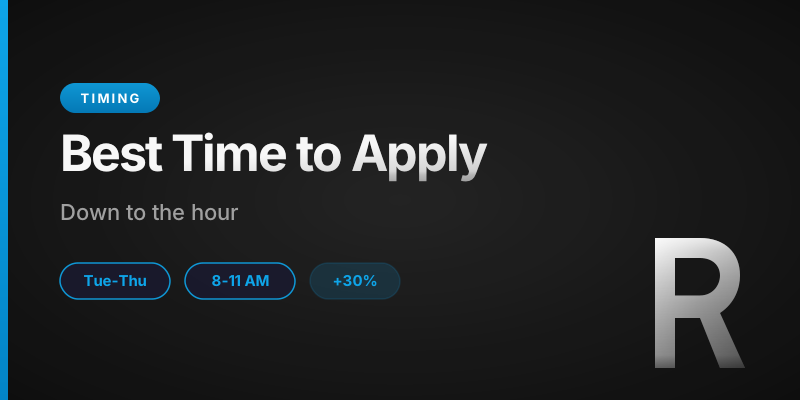
Timing your job application matters more than you think. Data shows Tuesday through Thursday between 8-11 AM gets 30% higher response rates. Here's the complete timing guide.

Raman M.
Software Engineer & Career Coach
On this page
Build a resume that gets interviews
- ATS-optimized templates
- AI-powered writing
- Free to start
No credit card required
You spent three hours perfecting your resume. You tweaked the bullet points, ran it through a spell checker twice, and formatted it exactly right. Then you hit "submit" at 11 PM on a Friday night.
That resume landed at the bottom of a digital pile that nobody will touch until Monday. By then, 200 other applicants have already stacked on top of you. The timing of your application matters almost as much as the content.
The Data: When Applications Get the Most Responses
According to a 2025 Talent Board study analyzing over 4 million job applications, applications submitted Tuesday through Thursday between 8 and 11 AM local time receive approximately 30% higher response rates compared to those submitted at other times.
Here is how the days break down:
| Day | Response Rate (Relative) | Notes |
|---|---|---|
| Monday | Average | Recruiters are clearing weekend backlog |
| Tuesday | +28% above average | Peak day for recruiter engagement |
| Wednesday | +31% above average | Highest response rates overall |
| Thursday | +24% above average | Strong, but slightly declining |
| Friday | -15% below average | Recruiters winding down for the week |
| Saturday | -40% below average | Most recruiting teams are offline |
| Sunday | -35% below average | Slightly better than Saturday as some prep for Monday |
The sweet spot is clear: Tuesday through Thursday, early to mid-morning.
Why Timing Affects Your Chances
This is not about luck or superstition. There are three concrete reasons timing matters.
1. ATS queue position. Most Applicant Tracking Systems display candidates in the order they are received, or sorted by most recent. When a recruiter opens their queue on Tuesday morning, the applications that arrived overnight on Monday sit at the top. Applications from the previous Friday have already been buried.
2. Recruiter workflow patterns. Recruiters typically batch their resume reviews. They block time on Tuesday, Wednesday, and Thursday mornings to screen candidates. If your application arrives during that window, it is more likely to be reviewed while the recruiter is actively engaged and making decisions. Submit on Friday afternoon, and your resume sits unread through the weekend.
3. The "first in stack" advantage. Research from Glassdoor suggests that the first 50 applicants to a job posting receive disproportionate attention. Recruiters spend more time on early applications because the pool feels manageable. Once hundreds pile up, screening becomes more ruthless.
Seasonal Timing: When Companies Hire Most
The day and hour matter, but the month matters too.
Peak hiring seasons in 2026:
- January and February: New budgets are approved. Headcount opens up. Hiring managers are motivated to fill roles early in the fiscal year.
- March through May: The strongest hiring period. Companies are in full execution mode, and competition for talent is high.
- September and October: A second wave after summer slowdowns. Teams want to fill roles before year-end.
Slow periods:
- Late November and December: Budget freezes, holidays, and decision-makers on vacation. Postings may stay active but decisions stall.
- July and August: Summer vacations slow the process. Interviews get rescheduled, and hiring committees are hard to assemble.
This does not mean you should stop applying during slow months. It means you should adjust your expectations and use those periods to network and refine your materials instead of expecting quick responses.
How to Time Your Applications Strategically
Here is a practical system for maximizing your timing advantage.
Apply Within 24 Hours of a Job Posting
The first 72 hours after a job is posted are the golden window. Response rates drop significantly after the first week. Job boards like LinkedIn and Indeed show you when a posting went live. Use that information.
If you see a role posted on Monday evening, do not wait until the weekend to apply. Get your application in by Tuesday or Wednesday morning. Even a slightly less polished application submitted on Day 1 often outperforms a perfect one submitted on Day 10.
Schedule Your Submissions
Most job boards let you draft applications and save them. Prepare your materials whenever it is convenient, but schedule or manually submit during the Tuesday through Thursday, 8 to 11 AM window in the company's local time zone.
If you are applying to a company in a different time zone, adjust accordingly. A company headquartered in New York processes applications on Eastern Time, not your local clock.
Follow Up After One Week
If you have not heard back within 5 to 7 business days, a brief follow-up email to the recruiter or hiring manager can put your name back on top. Keep it short: reference the role, reiterate your interest, and mention one specific qualification.
The follow-up itself should also be timed. Send it Tuesday or Wednesday morning, not Friday afternoon.
Putting It All Together
Your application timing checklist:
- Set up job alerts for your target roles so you see postings within hours, not days
- Prepare your base resume ahead of time with ResumeFast so you can tailor quickly
- Submit Tuesday through Thursday, 8 to 11 AM in the employer's time zone
- Apply within 24 hours of the posting going live (48 hours maximum)
- Follow up at the one-week mark if you have not heard back
Timing will not fix a weak resume. But when your resume is strong, submitting it at the right moment can be the difference between landing in a recruiter's active review pile and disappearing into the backlog.
For a broader strategy on making the most of the current job market, check out our Spring 2026 Job Search Strategy Guide. And if you want to understand what happens after you hit submit, our breakdown of hiring funnel benchmarks shows exactly where candidates drop off at each stage.
Frequently Asked Questions
Does it matter what time zone I use when timing my application?
Yes. Time your submission based on the company's local time zone, not yours. If the company is headquartered in San Francisco and you are in New York, submit at 11 AM Eastern so it arrives at 8 AM Pacific, right when their recruiting team starts their day.
Should I wait to apply if I find a job posting on a Friday?
Do not wait until the following Tuesday. The 24-hour rule takes priority over the day-of-week rule. Submit on Friday if the posting is fresh, but aim for early morning rather than late afternoon. A Friday morning application still beats a Tuesday application submitted a week after the posting went live.
Your resume is your first impression. Make it count.
Join 50,000+ job seekers using ResumeFast to build ATS-optimized resumes that actually get interviews.
No credit card required. Free forever.
Continue Reading
View all articles
Cover Letter vs Resume: Differences and When You Need Both
The Complete ATS Resume Guide (2026)
Resume Writing Guide: How to Write a Resume in 2026
Job Hopping in 2026: How Short Tenures Actually Read on Your Resume

New Grad Resume Guide: How to Get Hired in 2026 Without Experience
Defense and Cybersecurity Resume Guide: How to Land a Job in the Fastest-Growing Sectors of 2026
Build a resume that gets interviews
Ready to build your resume?